
Overview
Somewhere right now, someone is reliving an argument they had with their partner many times before, and can't seem to breakthrough the cycle. Someone else is watching themselves self-sabotage a business opportunity they genuinely want and can't explain why. A coaching client is having the same breakthrough for the third time and still can't seem to hold it. A program participant finishes a transformational retreat and within weeks is back where they started.
This is not a failure of will, intelligence, or the quality of the work. The work is real. What's missing is the infrastructure beneath it: a persistent map of what's actually happening inside a person, continuity across sessions so nothing is lost between them, and a method for connecting present-day reactions to their origins so a practitioner always knows with precision what to do next.
The inner life is somewhat predictable: patterns repeat, wounds compound, and unresolved experiences quietly organize behavior in ways the individual rarely has language for. The problem is that until now, no system existed to track any of it with precision, in order for it to predictably change.
How to Human is a structured data technology for observing, tracking, and guiding human transformation. It is designed to sit beneath any personal development, coaching, or healing program and give it continuity, precision, and measurable outcomes.
It is not a modality, a philosophy, or a self-help product. It is a foundational data model that can be licensed and adapted by organizations and practitioners to fit the specific program, audience, or customer base they serve. The core data model and structural concepts are fixed; the resource library, facilitation approach, and program design are customizable by the implementing organization.
The Problem It Solves
Personal development, healing, and coaching programs have mostly operated in the realm of the subjective. Progress lives inside the individual; in their felt sense, private reflection, and gradual shifts in behavior. Evidence of transformation is typically anecdotal: someone shares what changed for them, in their own words, as best they can remember it.
There is currently no shared infrastructure for capturing what is actually happening inside a person as they move through a healing or coaching program. There is no way to know which intervention produced which shift, at which moment, for which person. No way to track the deeper pattern beneath someone's surface-level experience, or to direct a practitioner with precision about what to do next. How to Human is built to fill that gap and stop the guesswork of the innerwork.
How It Works
The core premise of the system is that recurring, unwanted patterns often originate in unresolved past experiences that continue to shape present reactions. Effective transformation, in this model, emphasizes addressing these underlying drivers rather than solely modifying surface behavior.[1]
How to Human gives practitioners and individuals a structured way to identify that root, track how it changes over time, and determine the right intervention at the right moment, based on whatever modality or approach the implementing program uses. The system turns subjective inner experience into observable, structured data points that can be tracked across sessions. It enables identification of patterns across individuals and cohorts, offers precise resource recommendations, and measures outcomes over time. This transforms what has historically been intuitive and anecdotal into something that can be measured, replicated, and scaled.
The data model is also designed for both human interaction and AI integration: allowing for AI systems to analyze patterns, generate recommendations, identify next steps, and support facilitators in real time. How to Human does not replace the work a practitioner does, the modality they use, or the relationship between practitioner and participant. It is designed to enhance and support transformative programs by giving the work memory, a map, and a method for knowing what comes next.
Theory & Philosophy
All Data Is Relative
Everything How to Human records is relative to the person experiencing it. There is no absolute data in this model. Two people can live through the same event and come away with entirely different experiences of it, and both are true for them. A memory recalled in a Mapping Session is a personal narrative, not a factual record of what happened. The model works with the person's experience, because that experience is their reality and it is what their nervous system is still responding to.
This is why every intensity, category and belief in the system is captured as perceived, why no data point ever becomes a fixed label for the individual, and why a person's data is compared only with their own earlier data, never with anyone else's.[1]
Awareness as the Healing Mechanism
Research in predictive processing and interoceptive inference shows the brain continuously predicts internal and external signals.[1][2][3] Your nervous system responds to the world before conscious thought forms. The body tightens, the heart rate changes, the breath changes — all before you've decided anything. The system is dynamic and probabilistic.
Awareness is what allows those signals to become perceivable, differentiable, and workable. It lives in the narrow gap between stimulus (i.e., triggers) and the resulting experience and behaviour. In the How to Human model, awareness is what puts you back in the driver's seat of your life, and allows for the transformation to occur.
Awareness Has Measurable Properties
Awareness behaves like a system variable with observable states and modes that can fail or upgrade. Think of it like a camera:
- Aperture: how much of your experience you can hold at once
- Resolution: how finely you can differentiate signals from one another
- Fidelity: how accurate or distorted your signal is
- Stability: how long you can remain present without collapsing into reactivity
When someone is safe and connected, their aperture is wide, resolution is high, and learning happens readily. When someone is threatened, the aperture narrows, resolution drops, and everything reads as danger. Polyvagal Theory describes this as autonomic state shifting.
The goal of the How to Human system is not to eliminate threat responses but to progressively expand and build a person's capacity to remain present with more of their experience, more of the time, without being hijacked by it.
Awareness Has Polarity
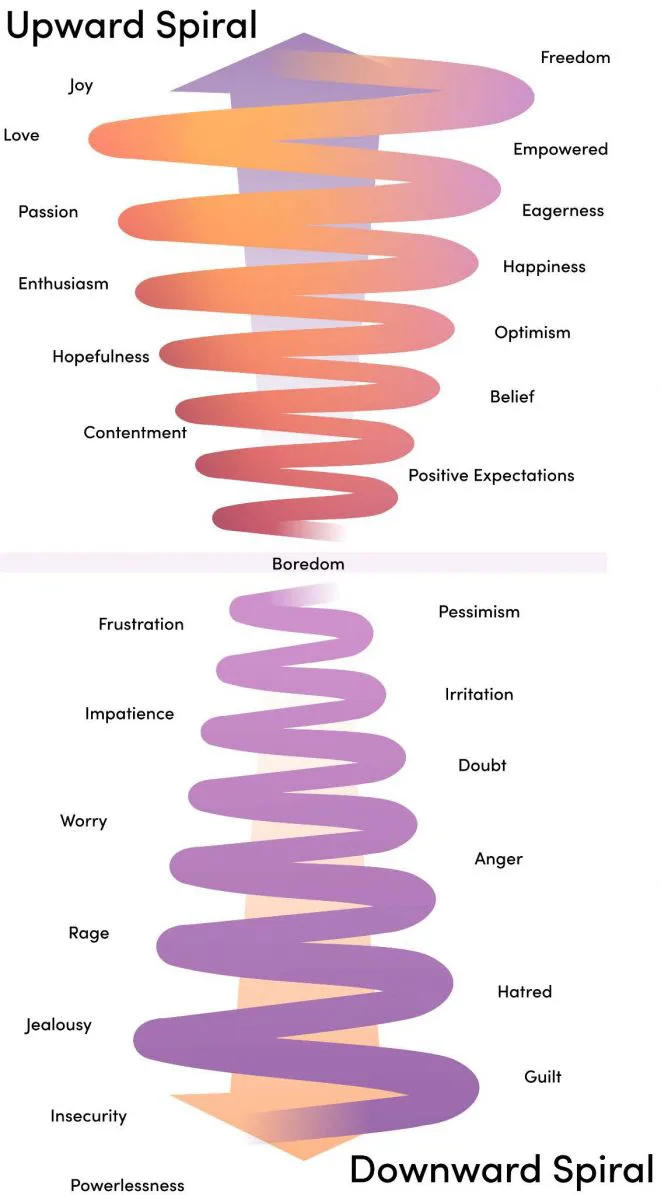
Awareness moves along a spectrum with two poles.[1]
- At the negative polarity: shadow, contraction, separation, and fear-based patterning. A trigger represents a negative-polarity event; a measurable shift toward defensiveness, contraction, and protective response patterns.
- At the positive polarity: connection, expansion, love, and coherence. An insight is a positive-polarity event; a moment of clarity, warmth, coherence, or relief.
Both are awarenesses. The system is designed to capture and work with the data of both. This maps onto what affective science describes as the dimensions of valence (positive to negative) and arousal (low to high intensity). [4]
This wave-like nature of awareness (oscillating between contraction and expansion) is the fundamental mechanism the transformation loop is built on. The goal is not to stay permanently in positive polarity, but to progressively expand the bandwidth of what the person can hold, integrate, and move through within both polarities.
The Core Formula
The governing formula of How to Human is:
Increased Awareness + Conscious Free Thought = Liberation
Increased awareness means expanding the range and clarity of what you can perceive about your own internal experience; your Triggers, patterns, beliefs, and the emotional data your nervous system is generating in real time.
Conscious free thought is the individual's capacity to think clearly without the distortion of unresolved subconscious patterns. It is not merely intellectual freedom, but the felt experience of having enough psychological safety and self-trust to ask for what you need, name what you are available for, and engage honestly with what is actually happening inside you. Conscious free thought is both enabled by safe containers and generates them.
Liberation is not a destination. It is the ongoing process of reducing the degree to which unconscious material defines your choices, behaviors, relationships, and experience of life.
Being Seen is Essential
Expanded awareness alone is not sufficient. The second core ingredient is witnessing; the experience of being seen by another person within a psychologically safe container while expanding your awareness.[5][1]
Healing does not happen in isolation. When a person is seen fully (without judgment, without fixing, without agenda) their nervous system can open to data it has been protecting itself from.[5]
The presence of a safe witness creates the relational conditions under which genuine Insights become available. This was demonstrated distinctly in the outcomes of the proof-of-concept program Liber8.[6]
This is why the How to Human system structures progressive witnessing into its technology:
- Being seen by a trained professional (1:1 Mapping Session)
- Being seen by a peer group (Buddy Groups, facilitated)
- Being seen by a trusted peer at an equivalent level of growth (Journey Mates)
Each stage expands both the depth of what can be revealed and the individual's capacity to hold that depth safely.
The Foundational Theory in Summary
| Element | What It Means in Practice |
|---|---|
| Expanded awareness | The actual mechanism of change; what the whole system is designed to generate |
| Psychological Safety | The condition that makes awareness expansion effective for growth and transformation |
| Witnessing | The relational component that unlocks what self-inquiry alone cannot reach |
| Data capture | How the system tracks awareness events (Triggers and Insights) over time |
| Transformation Loop | The repeatable process through which awareness expands, integrates, and produces lasting change |
Converging Theories
The theoretical basis for How to Human draws from several converging fields, elaborated in depth in the White Paper: The Impact of Emotional Health on Physical Wellbeing.[1]
1. Grof's COEX Theory
The foundational structural unit of How to Human is the COEX. This term was coined by Czech psychiatrist Stanislav Grof to describe a condensed emotional experience: a cluster of related memories organized around a powerful emotional center that the nervous system was unable to fully process at the time of their occurrence.[7] As Grof defines them, COEXes include all experiences that overwhelm the nervous system, storing information about the event across multiple parts of the body and mind.[7] In this model, COEXes stack over time, layered on top of a root experience that typically occurs before age seven. Present-day triggers are understood as ripples from these earlier stacks, not the event itself.
2. Erikson's Psychosocial Stage Theory
Grof's framework is layered with Erik Erikson's Psychosocial Stage Theory, which provides the developmental architecture through which COEX Stacks are organized and mapped.[8] Erikson proposed that every person moves through eight interrelated stages of development, each presenting a psychosocial crisis that, when unresolved, leaves the individual emotionally or psychologically arrested at that stage.[8]
How to Human tracks COEX(es) across all eight stages in reverse chronological order (from the present day back to early childhood) to build a picture of the full wound structure and where beliefs formed. Because the nervous system retains plasticity throughout life, resolving these developmental arrests remains possible at any age.[8]
3. Kübler-Ross Grief Model
The healing phases of How to Human are directly informed by Elisabeth Kübler-Ross's model of grief, which maps the psychological stages a person moves through when confronted with loss or incompleteness: denial, anger, bargaining, depression, and acceptance.[9] When an individual is stuck in a pattern driven by an unresolved COEX, the model uses the Kübler-Ross framework to identify which grief stage the person may be arrested in, and what specific emotional movement is needed to progress.[9] Reaching acceptance is the primary goal of the first healing phase (See to Accept), after which deeper learning and embodiment become possible.[1]
4. Trauma Neurobiology and Polyvagal Theory
Research emerging from Polyvagal Theory and attachment science suggests that the body encodes emotional experience at a physiological level. Autonomic responses are processed through the nervous system before conscious reasoning can engage, which is why cognitive interventions alone produce limited results with deeply rooted patterns.[10] The polyvagal theory articulates how the human autonomic nervous system is organized across three hierarchical subsystems governing social engagement, mobilization (fight/flight), and immobilization (shutdown).[11] A healthy parasympathetic nervous system response, governed by the vagus nerve, is essential for mental wellbeing and physical health.[12]
This is the physiological basis for psychological safety as a prerequisite for healing: the social engagement system must be active for new learning and emotional processing to occur.[11]
5. Attachment Theory
As proposed by John Bowlby, attachment describes the emotional bond between a caretaker and child that shapes the child's internal working model; their fundamental beliefs about safety, connection, and self-worth.[14] These models are largely formed before age seven and continue to organize adult relational patterns.[15] Attachment patterns are moderately stable over time, but they are not fixed; they continue to change across the lifespan, which is what makes healing them possible.[16] Insecure or disrupted attachment is one of the primary mechanisms by which COEX Stacks form and compound over time.[14]
Individual differences observed in infant attachment are manifested similarly in adult relationships.[17] How to Human's progressive witnessing structure; moving from a 1:1 Mapping Session to Buddy Groups to Journey Mates; is designed to create earned secure attachment through graduated relational safety.[18]
6. Psychoneuroimmunology
A well-established bidirectional relationship exists between emotional states and physical health. As Dr. Gabor Maté states, the science of psychoneuroimmunology has validated that emotion-processing centers of the brain are inextricably linked with the nervous system, the immune system, and the hormonal apparatus.[19] As neuroscientist Candace Pert observed, the conceptual division between immunology, endocrinology, and psychology is a historical artifact.[20] Unresolved emotional experience is not merely psychological; it is physiologically consequential, contributing to chronic dis-ease, inflammation, and immune dysregulation.[19][21]
7. Memory Reconsolidation Research
When stored emotional memories are reactivated, they can become temporarily malleable and available for updating. Reactivation alone is not enough: the memory updates when, while it is active, the person has an experience that contradicts what the memory expects (a "mismatch").[22][23] This is the neurological mechanism that makes the Mapping Session effective. Guiding a person back to the emotional origin of a pattern within a psychologically safe container reactivates the memory, and the experience of being witnessed, the Insights that surface and the Magic Keys supply the contradicting experience through which new associations can be encoded.[24]
8. Co-Regulation Research
The nervous system regulates most effectively within responsive relational environments. Co-regulation (the process by which one person's regulated nervous system helps others settle) is not a supplementary feature of healing but a primary mechanism.[25][26][11] The system's architecture, progressing from 1:1 Mapping Session to Buddy Groups to Journey Mates, is a direct structural expression of this principle, designed to progressively expand each individual's capacity to be seen and to see others across widening circles of relationship.[27]
9. Phase-Oriented Trauma Recovery
Psychiatrist Judith Herman described recovery from trauma in three stages: establishing safety, remembrance and mourning, and reconnection with ordinary life and other people.[28] How to Human's structure closely mirrors it. Grounding and psychological safety come first, in every Mapping Session and as the first of the Six Healing Steps. The Acceptance and Gratitude Healing Phases do the work of remembering and mourning. The Responsibility phase and the widening Relationship Layers carry the reconnection.
The Five-Step Transformation Loop
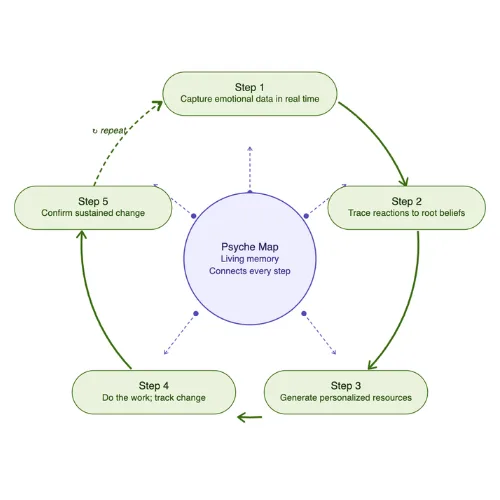
The How to Human system operates as a continuous loop. Each pass through the loop adds to what the system knows about the individual, deepens the picture of what is driving their patterns, and brings them closer to lasting resolution. At the center of the loop is the system's memory, called the Psyche Map: a growing, living record of everything that has been observed, captured, and changed.
- Step 1: The user captures emotional data in real time (Triggers, and Insights)
- Step 2: A facilitator or AI traces present-day reactions back to their root experiences and beliefs.
- Step 3: The system generates personalized resources and tools matched to what was discovered
- Step 4: The individual does the work while the system tracks signs of change.
- Step 5: Sustained change is confirmed, and the loop begins again.
System at a Glance
Summary Table
| Stage | What Happens | Operational Tools Used | Data Created | Impact on Psyche Map |
|---|---|---|---|---|
| 1.Track | The individual logs real-time emotional activations (triggers) and moments of awareness (insights) |
|
|
Begins populating itself with present-day emotional data |
| 2.Map | A facilitator or AI connects present-day reactions to the root experiences and beliefs driving them |
|
|
Wound architecture populates and becomes visible on the Psyche Map |
| 3.Recommend | Recommendation Engine generates a personalized intervention plan matched to what was discovered | Personalized recommended resources, tools, and practices (including Magic Keys) | The system reads Psyche Map data and outputs are generated and delivered to the individual | |
| 4.Heal | The individual applies the recommendation and continues to track emotional data while the system monitors change |
|
Continuously updated. Progress tracked across sessions, community, and daily life | |
| 5.Integrate | Sustained change is confirmed, anchored into identity, and the loop completes |
|
Transformation (shift) recorded. Resolved patterns documented. Map enriched for next cycle | |
| * Repeat * | The cycle continues as new emotional data emerges | — | — | Ongoing evolution of the Psyche Map |
Stage by Stage: How Each Step Works
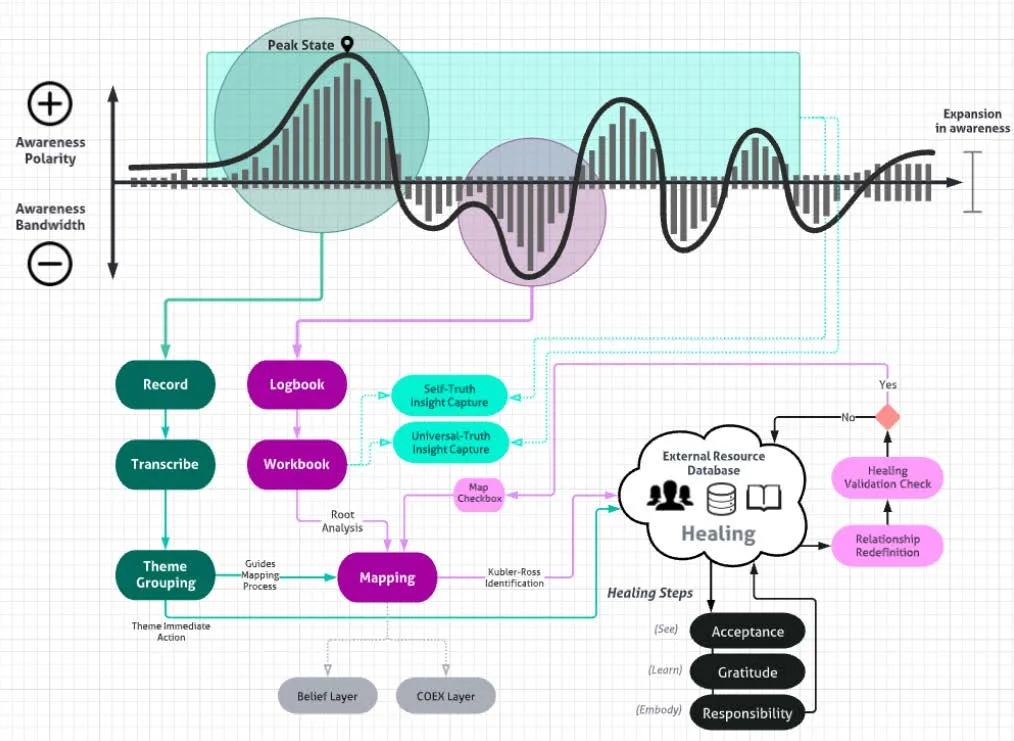
Editorial note: The following is a distilled, practitioner-facing description of the How to Human operational sequence. The complete system architecture, including all data flows, feedback loops, input/output relationships, and decision logic, is represented in full in the System Overview (right) and the How to Human Data Schema (below). This written summary prioritizes accessibility and clarity for new readers; the diagram remains the authoritative reference for technical and implementation detail.
Track
The individual logs two types of real-time data using the app: Triggers (moments of emotional activation such as anxiety, anger, or shutdown) and Insights (moments of new awareness or clarity). Both are captured with associated context and data properties. This continuous stream of present-day data is the entry point for the entire system and the way in which the Psyche Map updates itself to reflect where the user is in their journey of transformation.
Map
A trained space holder leads a 90-minute Mapping Session, a guided conversation that traces the individual's present-day Triggers back through their personal history to identify the root COEX past experiences and resulting Learned Limiting Beliefs (LLB) driving them.
These root experiences are called COEXes (Condensed Emotional Experiences). Each COEX can carry one or more associated Learned Limiting Beliefs: the conclusions the psyche formed at the time of the experience. Each COEX is also classified by its Binding Sites (where the wound is held: Mind, Body, Heart, or Spirit), Relationship Layer (the relational context in which it formed), and nervous system response type. Related COEXes group together into a COEX Stack, anchored by the earliest experience in the pattern, called the Root COEX. All session data is entered into the system via the Notetaker Upload, where it becomes the structural layer of the Psyche Map and contributes to the next phases of the system.
Recommend
The Recommendation Engine reads the Psyche Map and generates a personalized intervention plan. One or more Magic Keys (perceptual frameworks the individual must internalize to move through their healing) are assigned based on the COEX and the Psyche Map. Resources, daily practices, and next steps are delivered to the individual in the Emotional Lab Report (ELR), a personalized written document of the Mapping Session. Every recommendation is matched to the specific nature of the wound structure discovered, its associated properties, and the data indicators of where the user is in their journey of healing and transformation.
Heal
The individual engages with their recommended resources, works with their assigned Magic Keys, continues logging Triggers and Insights, and participates in the relational structure of their program through 1:1 sessions, group calls, and community interactions (as the modality or program sees fit). As they do, observable signs of change are captured from any program interaction as Healing Indicators and logged via the Healing Indicator Upload. The Psyche Map is updated continuously. The Healing Phases (the stage the individual is moving through) is tracked across all interactions to ensure the right intervention and resource is always matched to the right moment.
Integrate
When Healing Indicators show a consistent, sustained pattern of change, a Shift is documented via the Shift Upload: a confirmed update to the individual's way of being, linked to the specific COEX(es) involved and the resources that contributed. This can be done by a facilitator within an interaction with the user (individual or group setting), or by the system using AI prompts and user-entered data. When the emotional charge of a COEX Stack is fully resolved and no longer activating, this is called a COEX collapse. The individual then completes the Relationship Redefinition Exercise, articulating new boundaries and agreements, and writes a Legacy Statement (a self-created declaration of identity that directly counters their core belief). The transformation cycle completes. The Psyche Map is updated with the resolved pattern, and the cycle begins again with greater precision and new emotional data.
Data Architecture: Schema and Model
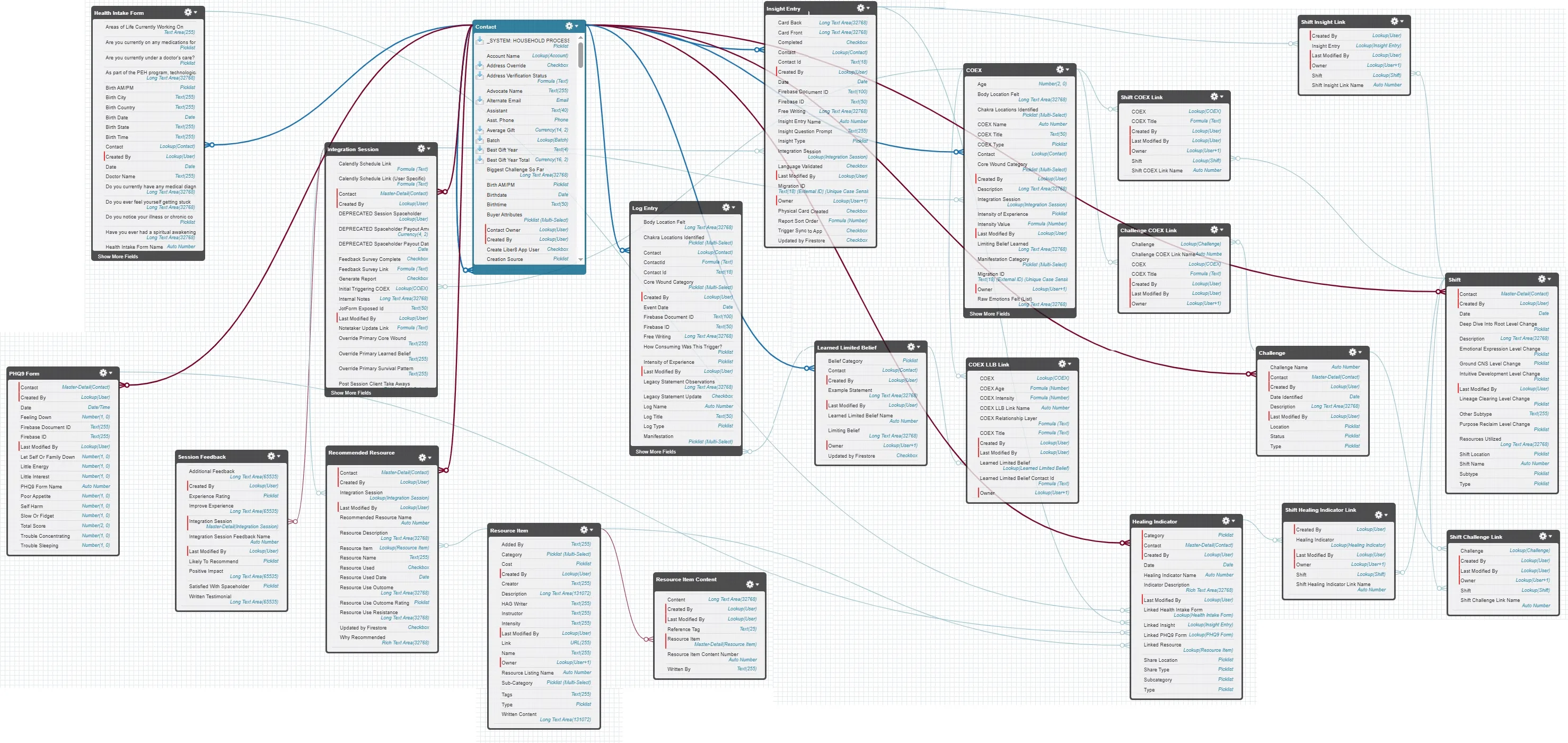
The following graphic illustrates the raw data design and relationship between data sets.
Glossary of Terms
Data Objects
The following are data objects that get tracked by the How to Human system . They exist as their own records in the database, linked to other records and properties.
Trigger
Definition: A present-day emotional activation (e.g., anger, sadness, shutdown, reactivity, anxiety) that indicates an underlying unresolved emotional experience. Triggers are negative-polarity data points. A Trigger activates a COEX or COEX Stack: the past emotional data that still carries charge. Where COEXes hold the root of the pattern, Triggers are its present-day signal. The Mapping Session is what connects them.
System Role: Triggers are the primary self-service entry point into the system. When a user logs a Trigger, they capture the most current signal their nervous system is generating. That signal becomes the starting data point for pattern recognition, future Mapping Sessions, and transformation tracking. Triggers decreasing in frequency and intensity over time are key Healing Indicators that a shift is occurring as an underlying emotional pattern resolves.
Trigger Data Properties: Core fields captured during real-time trigger logging by the user. These fields form the foundational dataset used for downstream pattern mapping and analysis.
| Field | Type | Description |
|---|---|---|
| Contact | Master-Detail (Contact) | Linked individual — master record |
| Trigger Date | Date | Date of the activation event |
| Log Title | Text | Short descriptive title for the log entry |
| Log Type | Picklist | Classification of log type |
| Trigger Type | Picklist | Category of trigger event |
| Intensity | Text / Scale | Perceived intensity of activation (1–10) |
| How Consuming Was This Trigger | Text / Scale | Degree of amygdala hijacking / emotional takeover |
| Post-Entry Intensity of Experience | Text / Scale | Re-rated intensity after logging (comparison data point). Naming a feeling in words measurably calms the brain's alarm response ("affect labeling"), so intensity often drops just from logging.[29] |
| What Happened | Long Text | Perceived external cause or triggering event |
| Why It Happened | Long Text | Individual's interpretation of why it occurred |
| Body Location Felt | Text | Physiological sensations at time of activation |
| Chakra Locations Identified | Multi-Select | Energy centers associated with the activation |
| Raw Emotions Felt List | Multi-Select | Emotions present at time of trigger |
| Manifestation | Picklist | How the trigger manifested (Anxiety / Depression / Control / Conflict / Chronic Pain) |
| Core Wound Category | Picklist | Pattern category (Rejection / Abandonment / Humiliation / Betrayal / Injustice), adapted from Lise Bourbeau's five wounds[30] |
| Response Direction | Picklist | Pulled In or Pushed Upon |
| Response Type | Picklist | Fight / Flight / Freeze / Fawn[31] |
| Response Actions | Text | Specific actions taken in response |
| Relationship Layer | Picklist | Relationship context of the event |
| Free Writing | Long Text | Additional elaboration in the individual's own words |
| Similar Past Experience | Long Text | Related past memory surfaced by the trigger |
| What Beliefs Emerged | Long Text | Beliefs or self-narratives that arose during activation |
| Legacy Statement Observations | Long Text | Any observations relevant to existing legacy statement |
| Legacy Statement Update | Checkbox | Flags whether this log has prompted a legacy statement revision |
| Was Legacy Statement Test | Checkbox | Flags whether this log was a test of the legacy statement's durability |
Example
Dave is dating someone new. She hasn’t replied to his text for six hours. He begins to feel anxious, insecure, and assumes the relationship is at risk. He logs the experience in the app as part of the men’s group program he joined. This logged trigger becomes the entry point for mapping the deeper pattern driving his reaction.
Insight
Definition: A newly recognized understanding about one's emotional patterns, beliefs, or past experiences that shifts perception or brings unconscious material into conscious awareness. Insights are positive-polarity data points: moments of clarity, relief, warmth, or coherence. They are captured in the individual's own language and typed as self-truths or universal truths.
System Role: While Triggers capture what is emotionally activating in the present, Insights capture what is becoming understood. Together, they create the positive and negative polarity data entry that feeds the entire tracking and mapping system and defines the individual's transformation. Insights are linked to COEXes and tracked over time to indicate progression and resolution. Insights are the data that seed Healing Indicators and resulting Shifts within the system.
Data Properties: User-entered via the application or captured during a Mapping Session.
| Field | Type | Description |
|---|---|---|
| Contact | Master-Detail (Contact) |
Linked individual — master record |
| Date | Date | Date the insight was recorded |
| Insight Type | Picklist | Categorization of the insight: Self Truth or Universal Truth |
| Insight Question Prompt | Text | The prompt question that stimulated the insight, if applicable |
| Card Front | Long Text | The core insight statement in the individual's own words — the primary truth being anchored |
| Card Back | Long Text | A supporting statement that reinforces the emotional reality of the insight |
| Free Writing | Long Text | Additional context or elaboration in the individual's own words |
| Language Validated | Checkbox | Indicates a facilitator has reviewed and confirmed the insight language accurately reflects the individual's own voice |
| Completed | Checkbox | Flags whether the insight has been fully processed within the system |
| Physical Card Created | Checkbox | Flags whether a physical insight card has been printed or created for this record |
Linked Data Properties (Insight ↔ Shift): This junction object creates the many-to-many relationship between Insight records and Shift records. A single Shift can be linked to multiple Insights, and a single Insight can be referenced across multiple Shifts.
| Field | Type | Description |
|---|---|---|
| Insight Entry | Lookup (Insight Log) | The insight record being associated with the Shift |
| Shift | Lookup (Shift) | The Shift record this insight contributed to or evidenced |
| Shift Insight Link Name | Auto Number | Auto-generated identifier for the junction record |
Example
After logging the trigger, Dave recalls that he has a deep fear of abandonment rooted in a childhood experience of being overlooked. He logs this realization as an insight: “My anxiety about being left isn’t about her. It’s about something much older.” This insight becomes a key data point that guides the Mapping Session and subsequent processes and recommendations within the system.
Condensed Emotional Experience (COEX)
Definition: A past emotional experience that the nervous system stored because it could not fully process it at the time, typically because safety or connection were unavailable. A COEX is a memory-emotion-belief package: a specific moment in time, at a specific age, carrying specific emotional charge and an associated limiting belief that continues to influence present-day reactions. The term was coined by psychiatrist and psychedelic therapy researcher [Stanislav Grof] to describe how the psyche clusters emotionally similar experiences into belief systems that activate as a whole and shape recurring patterns in perception and behavior.
System Role: Triggers show what is happening in the present. COEXes explain why. Each COEX is an individual data point surfaced during a Mapping Session and entered into the system. COEXes are the primary structural unit of the wound architecture. The system organizes them into patterns (COEX Stacks), maps them by various properties, and uses those properties to drive the Recommendation Engine. Identifying and resolving COEXes is the core mechanism by which the system produces lasting transformation.
Data Properties: Entered by the facilitator via the Notetaker Upload following a Mapping Session.
| Field | Type | Description |
|---|---|---|
| Contact | Master-Detail (Contact) |
Linked individual — master record |
| COEX Title | Text | Short identifying title for the COEX record |
| COEX Type | Picklist | Classification of the COEX (e.g., Root, Layered) |
| Age | Number | Age at which the COEX event occurred |
| Intensity | Text / Scale | Perceived intensity of the event at time of recall (1–10) |
| Intensity Value | Number | Numeric intensity value used for calculations and reporting |
| Description | Long Text | Narrative of the past event in the client's own words — what happened, what was felt, what was believed |
| Body Location Felt | Text | Physiological sensations recalled from the event |
| Chakra Locations Identified | Multi-Select | Energy centers associated with the stored experience |
| Raw Emotions Felt List | Multi-Select | Emotions present in the recalled experience |
| Core Wound Category | Picklist | Rejection / Abandonment / Humiliation / Betrayal / Injustice |
| Manifestation | Picklist | Anxiety / Depression / Control / Conflict / Chronic Pain |
| Response Direction | Picklist | Pulled In or Pushed Upon |
| Response Type | Picklist | Fight / Flight / Freeze / Fawn |
| Relationship Layer | Picklist | The relational context in which the wound was formed and is bound |
| Limiting Belief Learned | Long Text | The belief formed as a result of this COEX event, in the individual's own words |
| Rewiring Belief | Long Text | The replacement belief being cultivated as the COEX resolves — used in integration work |
Linked Data Properties (COEX ↔ Shift) : This junction object creates the many-to-many relationship between COEX records and Shift records. A single Shift can link to multiple COEXes, and a single COEX can appear across multiple Shifts.
| Field | Type | Description |
|---|---|---|
| Shift COEX Link Name | Auto Number | Auto-generated identifier for the junction record |
| Shift | Lookup (Shift) | The Shift record this COEX is associated with |
| COEX | Lookup (COEX) | The COEX being linked to the Shift |
| COEX Title | Formula (Text) | Auto-populated display name pulled from the linked COEX record |
Linked Data Properties (COEX ↔ Challenge) : This junction object creates the many-to-many relationship between COEX records and Challenge records. Challenges representing the wound structures actively blocking or complicating the individual's healing progress. Challenge links represent shadow and what is still in the way of transformation.
| Field | Type | Description |
|---|---|---|
| Challenge COEX Link Name | Auto Number | Auto-generated identifier for the junction record |
| Challenge | Lookup (Challenge) | The Challenge record this COEX is associated with |
| COEX | Lookup (COEX) | The COEX being linked to the Challenge |
| COEX Title | Formula (Text) | Auto-populated display name pulled from the linked COEX record |
Linked Data Properties (COEX ↔ LLB) : This junction object creates the many-to-many relationship between COEX records and LLB records. Each COEX may generate one or more LLBs; this junction captures that relationship and carries forward key COEX properties for reporting and recommendation use.
| Field | Type | Description |
|---|---|---|
| COEX LLB Link Name | Auto Number | Auto-generated identifier for the junction record |
| COEX | Lookup (COEX) | The COEX record being linked to the LLB |
| COEX Title | Formula (Text) | Auto-populated display name from the linked COEX record |
| COEX Age | Formula (Number) | Age value pulled from the linked COEX — used for developmental mapping |
| COEX Intensity | Formula (Number) | Intensity value pulled from the linked COEX — used for weighting and reporting |
| COEX Relationship Layer | Formula (Text) | Relationship layer pulled from the linked COEX — used for recommendation sequencing |
| Learned Limited Belief | Lookup (LLB) | The Learned Limiting Belief being associated with this COEX |
Example
In a Mapping Session, Dave recalls a memory of waiting at school at age seven where he felt similarly abandoned. This memory becomes a COEX data point, and the details associated with this memory become the COEX properties entered into the system. These data point links directly to the trigger he logged, revealing the root of a pattern that has been playing out throughout his life.
COEX Stack
Definition: A cluster of multiple COEXes linked by shared emotional charge, core wound category, or related limiting beliefs, forming a repeating emotional and behavioral pattern across a person's life. The stack originates from a Root COEX (the earliest, deepest version of the wound) and accumulates new layers each time the nervous system encounters a similar experience. Most recurring human patterns are not caused by a single event. They are reinforced by multiple overlapping experiences over time. The COEX Stack is the system's primary structural representation of this layering. It shows how individual COEXes connect and why a given Trigger feels so strong and familiar. Transformation requires addressing the whole stack, not just isolated events.
System Role: COEX Stack is a conceptual construct, not a discrete data object. The stack is a system-derived grouping, and not a standalone object that gets directly created or edited. The system infers it from the relationships between individual COEX records that share the same core wound category, Relationship Layer, and LLB patterns.
Example
After several mapping sessions, Dave has identified experiences at ages 7, 11, 15, and 22 that all carry the same emotional signature: anxiety around abandonment, and the belief "I am not important enough to be chosen." Together, these form a COEX Stack. His trigger — a text not being returned — is not about the text. It is an activation of the entire stack.
Root COEX
Definition: The earliest COEX in a COEX Stack, typically formed before age seven during the most formative period of neurological and psychosocial development. The Root COEX carries the original Learned Limiting Belief. All subsequent COEXes in the stack tend to reinforce and elaborate this core belief. The mapping process works backwards through developmental age brackets toward the Root COEX. The Root COEX is the origin point of the pattern being addressed. Identifying it is the goal of the Mapping Session's chronological regression. Healing work that reaches the Root COEX is more likely to produce lasting change because it addresses the belief at the point of formation, rather than only at its later expressions.[1]
System Role: Root COEX is a conceptual construct, not a discrete data object. It is a system-derived designation, and not a standalone object that gets directly created or edited. The system identifies it as the earliest COEX record within a COEX Stack, determined by age and the origin point of the pattern's LLB formation.
Example
During his third Mapping Session, the chronological regression reaches its earliest point. Dave recalls being four years old, sitting at the top of the stairs listening to his parents argue late at night, feeling invisible and certain that no one was coming. No memory before this one carries the same charge. This is his Root COEX — the original moment the belief "I am not important enough to be chosen" was formed. Every abandonment experience that followed, at ages 7, 11, 15, and 22, was the nervous system recognizing a familiar feeling and reinforcing the same conclusion. The work of healing the stack begins here.
Learned Limiting Belief (LLB)
Definition: A conclusion formed during a COEX event about oneself, others, or the world that becomes internalized and shapes future perception, behavior, and emotional responses. LLBs are not objective truths. They are interpretations the nervous system drew to make sense of an overwhelming experience, often in moments of intense emotion and without adequate attunement from caregivers.[1] Once formed, an LLB embeds within the COEX and is reinforced across similar experiences, becoming the cognitive foundation of a COEX Stack. The goal of healing is not to argue against LLBs intellectually, but to update them experientially through new safety, new truth, and new relational experiences, as directed by the resources and interventions generated by the Recommendation Engine.
System Role: LLBs are the primary data property of every COEX and COEX Stack. They are the core drivers of recurring Triggers and emotional patterns. They are extracted from the Mapping Session and become one of the main inputs to the Recommendation Engine for selecting appropriate interventions. LLBs are also the direct target of the Legacy Statement within the Relationship Redefinition Exercise.
Data Properties: Entered by the facilitator via the Notetaker Upload following a Mapping Session.
| Field | Type | Description |
|---|---|---|
| Contact | Master-Detail (Contact) |
Linked individual — master record |
| LLB Name | Auto Number | Auto-generated identifier for the LLB record |
| Limiting Belief | Long Text | The belief statement formed during the Condensed Emotional Experience (COEX) |
| Example Statement | Long Text | A contextual statement describing how this belief was experienced or internalized |
| Belief Category | Picklist | Categorization of the fundamental belief type (e.g., I am not enough / I am not safe / I am not worthy / Others are not safe / The world is not safe) |
Linked Data Properties (LLB ↔ COEX): This junction object creates the many-to-many relationship between COEX records and LLB records.
| Linked Object | Type | Description |
|---|---|---|
| Contact | Master-Detail (Contact) |
The individual this LLB record belongs to |
| COEX LLB Links | Junction (COEX LLB Link) | Connects this LLB to one or more Condensed Emotional Experience (COEX) |
| Logbook | Child Records | Log entries associated with this LLB |
Example
During the Mapping Session, as Dave recalls being seven years old waiting to be picked up, he identifies the belief that formed in that moment: “I am not important enough to be chosen.” This LLB is documented, linked to the COEX, and becomes a primary input to the Recommendation Engine for selecting resources that will address this specific belief pattern.
Future Development
This section reflects the Liber8 proof-of-concept implementation and may evolve in future versions of the system. The data objects, fields, and logic described here were tested and validated within the Liber8 program. For future applications, all LLBs distill to one of five core fears. Linking LLBs to their root fear is a planned addition to this schema. This layer will enable deeper coaching precision by addressing root fear directly, rather than only the surface belief. Field names, data types, object relationships, and specific properties will be adapted as the system is built out across new contexts.
Magic Keys
Definition: Magic Keys are perceptual frameworks and philosophical concepts that must be internalized to move through the Healing Phases. They are not affirmations or cognitive reframes, but understandings embedded through lived experience and integration practice. Magic Keys are the mechanism by which an individual moves away from Triggers and COEX patterns and toward Healing Indicators and Shifts. They are modality-neutral and can be layered into any coaching, healing, or therapeutic approach — serving as integration anchors for the individual and trackable progress markers for the system.
Relationship to Healing Phases and Dimensions (Mind/Body/Heart): Magic Keys are not tied to a single Healing Phase. They are awareness shifts that become accessible and necessary at specific points in the journey, and some apply across multiple phases. Within each Healing Phase, the individual is asked to do work across three dimensions: mind, heart, and body. Magic Keys are the specific perceptual shifts that make that work possible in each dimension.
A single key can serve different people at different phases depending on where their wound is held and what dimension of themselves it is most bound in (mind, body, or heart). This is why Magic Keys are assigned by the facilitator based on the individual's specific COEX map data rather than applied as a universal sequence. The mind/body/heart framing describes where in the person the key needs to land. It indicates the dimension through which a given key is integrated.
System Role: Magic Keys function as an analytical framework rather than a data object. Following a Mapping Session, the facilitator assigns relevant Magic Keys based on the COEX data. The Recommendation Engine tags resources, practices, and recommendations to these Magic Keys, which the individual works with between sessions. As a key is internalized, it reduces the emotional charge of the associated COEX and enables progression through the transformation of the COEX Stack. The system tracks which keys have been assigned and internalized, using this as a marker for Healing Indicators and Shifts.
Data Properties:
| # | Core Perception | Primary Binding Site | Primary Healing Phase |
|---|---|---|---|
| 1 | “See through the eyes of the other.” | Heart | Acceptance → Gratitude |
| 2 | “See through the eyes of your parts.”[32] | Body | Acceptance |
| 3 | “See through the eyes of divine love.” | Heart / Spirit | Gratitude |
| 4 | “Perception is reality. Every experience is valid.” | Mind | Acceptance |
| 5 | “Reframe unsafe as uncomfortable.” | Mind / Body | Acceptance |
| 6 | “Everything you do is an act of self-love.” | Mind | Acceptance |
| 7 | “Wounds aren’t healed — your perspective of the wound changes.” | Mind | Acceptance → Gratitude |
| 8 | “If you love who you are today, you have to love everything that made you who you are.” | Mind | Acceptance |
| 9 | “Taking ownership is the pathway to freedom.” | Mind | Responsibility |
| 10 | “Feel all the feels.” | Heart / Body | All phases |
| 11 | “Compassion is key.” | Heart | All phases |
| 12 | “Every response is training your mind.” | Mind | Responsibility |
| 13 | “Take your power back.” | Mind | Gratitude → Responsibility |
| 14 | “No regrets. Everything is perfect right now.” | Mind | Acceptance |
| 15 | “They were doing the best they could.” | Heart | Acceptance → Gratitude |
| 16 | “Things happen for me, not to me.” | Mind | Acceptance |
| 17 | “Things happen through me.” | Mind / Body | Responsibility |
| 18 | “Things happen as me.” | Mind / Body / Spirit | Responsibility |
Example
Dave’s Mapping Session facilitator assigns Magic Key 1 “See through the eyes of the other” based on the abandonment pattern in his COEX map. Working with this key, Dave reflects on his childhood experience and considers that his parents may have been overwhelmed rather than intentionally neglectful. This perspective shift generates a new insight: “This wasn’t about my importance. It was about their capacity.” That insight is logged and begins to reduce the emotional charge of the original COEX.
Implementation Note:
In the Liber8 implementation, three Magic Keys were assigned to each person: "See through the eyes of the other," "See through the eyes of your parts," and "See through the eyes of divine love, unity, and oneness." These three keys underpin all of the core healing work in Semester 1 and are considered the foundational perception shifts from which all other healing flows. The full Magic Key library is available in more personalized or advanced implementations.
Healing Indicators
Definition: Observable, categorizable signs that an individual is progressing toward a Shift. They are not the Shift itself; they are the evidence trail. Healing Indicators can be captured from any program interaction (e.g., a comment on a community call, a self-reported insight, a quiz result, a shared Legacy Statement, a testimonial, etc.). They are logged via the Healing Indicator Upload by facilitators or AI-assisted systems.
System Role: Healing Indicators are data objects that help the facilitation team track progress direction and momentum before a confirmed Shift. They provide input data to the Recommendation Engine and, when accumulated, support formal documentation of a Shift. They make the change process visible and measurable throughout the program, not only at milestone moments.
Data Properties: Captured by a facilitator via the Healing Indicator Upload, or self-reported by the individual through the application.
| Field | Type | Description |
|---|---|---|
| Contact | Master-Detail (Contact) |
Linked individual — master record |
| Healing Indicator Name | Auto Number | Auto-generated identifier for the record |
| Date | Date | Date the Healing Indicator was recognized and captured |
| Type | Picklist | High-level classification of the indicator: Assessment, Insight, Share, or Quiz |
| Share Type | Dependent Picklist | Format of the share, if Type is Share: Expression, Legacy Statement, or Testimonial |
| Category | Picklist | The dimension of healing the indicator reflects: Body / Mind / Heart / Spirit / Social / Embodied |
| Subcategory | Dependent Picklist | Secondary classification refining the Category — see Category & Subcategory Values below |
| Share Location | Picklist | Where the indicator was expressed or captured (e.g., Mapping Session, Community Call, Integration Session) |
| Indicator Description | Rich Long Text | Qualitative description of the observed change or share — content shared by the client, assessment improvement summary, insight notes, or quiz results. Acts as an aggregate capture field |
| Linked Insight | Lookup | Related insight entry connected to the healing indicator |
| Linked Resource | Lookup | Resource or intervention connected to the observed change |
Healing Indicator Categories: represent the dimensions of the human system through which healing becomes observable. Each category captures a distinct type of change. Together they ensure that transformation is measured across the whole person, not just one dimension.
| Category [Picklist] | Subcategory [Dependent-Picklist] | Associated Healing Shift Experience |
|---|---|---|
| Body |
|
|
| Mind |
|
|
| Heart |
|
|
| Spirit |
|
|
| Social |
|
|
| Embodied |
|
|
Linked Data Properties (Healing Indicators ↔ Shift): This junction object creates the many-to-many relationship between Healing Indicator records and Shift records, forming the evidence trail that confirms a Shift has occurred. A single Shift can be supported by multiple Healing Indicators, and a single Healing Indicator can be referenced across multiple Shifts.
| Field | Type | Description |
|---|---|---|
| Shift Healing Indicator Link Name | Auto Number | Auto-generated identifier for the junction record |
| Shift | Lookup (Shift) | The Shift record this Healing Indicator contributed to |
| Healing Indicator | Lookup (Healing Indicator) | The Healing Indicator being linked to the Shift |
Example
Over the weeks following his third Mapping Session, several Healing Indicators are captured across different interactions. On a community call, Dave shares that he noticed himself feeling calm when a friend cancelled plans last minute, something that would have sent him into a spiral six months earlier. The facilitator logs this in the Healing Indicator Upload. Two weeks later, Dave logs an insight in the app: "I didn't need her to text back to know I'm okay." The system tags this as a second Healing Indicator linked to the abandonment COEX Stack. At his next check-in, a quiz result shows a measurable decrease in anxiety frequency since intake. Together, these three indicators build the evidence trail that a Shift is occurring. No single one of them confirms it. All three Healing Indicators together support the facilitator in documenting a Shift.
Future Development
This section reflects the Liber8 proof-of-concept implementation and may evolve in future versions of the system. The data objects, fields, and logic described here were tested and validated within the Liber8 program. Implementing organizations should treat this as a reference model. Field names, data types, object relationships, and specific properties may be adapted as the system is built out across new contexts.
Challenge
Definition: A documented obstacle (or "shadow aspect") that is actively impeding a client's healing progression. Where a Shift records forward movement, a Challenge records what is in the way: the patterns, circumstances, or resistances that keep a client stuck, slow their progress, or cause regression across Healing Phases.
System Role: A Challenge allows the system to document recurring obstacles linked to COEX(es), and create a structured record of what is blocking a user from healing progress at any given point in their journey (e.g., emotional suppression, insufficient grounding, major life disruption). The system tracks the lifecycle of the challenge; when it was first identified, its progression across Healing Phases, and enables historical reporting on when and how obstacles were addressed. A single Challenge can be referenced across multiple Shifts, and a single Shift can surface multiple Challenges, creating a many-to-many relationship that accurately reflects the nonlinear nature of transformation work.
Data Properties: Captured by a facilitator or team member's documentation. Not shared with the client directly.
| Field | Type | Description |
|---|---|---|
| Contact | Master-Detail (Contact) |
Linked individual — master record |
| Challenge Name | Auto Number | Auto-generated identifier for the Challenge record |
| Type | Picklist | Internal categorization of the primary obstacle. Not shared with clients directly. See Type Values below |
| Date Identified | Date | Date the Challenge was first recognized by a facilitator or team member |
| Description | Long Text | Aggregate notes on the obstacle present. Captures undiscovered Condensed Emotional Experience (COEX) |
| Status | Picklist (History Tracking On) | Tracks the lifecycle of the Challenge: Active / Healing / Resolved |
| Location | Picklist | Where the Challenge was first identified (e.g., Mapping Session) |
Challenge Type Values
| Value | Description |
|---|---|
| Life event, health, or schedule challenges | External disruptions reducing capacity for the work |
| Insufficient grounding and regulation | Nervous system not stable enough to support deep dive work |
| Mental resistance to deep dive work | Cognitive or protective resistance to engaging with root material |
| Emotional suppression | Active avoidance or inability to access emotional experience |
| Spiritual or emotional bypassing | Using spiritual or positive frameworks to avoid deeper processing |
Linked Data Properties (Challenge ↔ Shift): This junction object creates the many-to-many relationship between Challenge records and Shift records. A single Shift can surface multiple Challenges, and a single Challenge can appear across multiple Shifts.
| Field | Type | Description |
|---|---|---|
| Shift Challenge Link Name | Auto Number | Auto-generated identifier for the junction record |
| Shift | Lookup (Shift) | The Shift record this Challenge is associated with |
| Challenge | Lookup (Challenge) | The Challenge being linked to the Shift |
Linked Data Properties (Challenge ↔ COEX): This junction object creates the many-to-many relationship between Challenge records and COEX records.
| Field | Type | Description |
|---|---|---|
| Challenge COEX Link Name | Auto Number | Auto-generated identifier for the junction record |
| Challenge | Lookup (Challenge) | The Challenge record this COEX is associated with |
| COEX | Lookup (COEX) | The COEX being linked to the Challenge |
| COEX Title | Formula (Text) | Auto-populated display name pulled from the linked COEX record |
Implementation Note:
The Challenge object was added as a standalone record in the last redesign of the system. Prior to this, challenge data was captured as a long-text aggregate field inside the Shift object. Separating it enables proper lifecycle tracking, recurring-pattern analysis, and future AI recommendation sequencing across a client's full timeline.
Shift (COEX Collapse)
Definition: A clearly observable, definable, sustained change in an individual's way of being that is confirmed through accumulated Healing Indicators. A Shift that results in a COEX no longer activating its associated Triggers is called a COEX Collapse. These terms refer to the same event. COEX Collapse is the primary goal of the healing process. It is rarely instant; it unfolds through repeated passes through the system loop.
System Role: Shifts are documented via the Shift Upload and linked to the specific COEX(es), Healing Indicators, and resources involved. They represent the system's highest-level transformation evidence. A documented Shift produces a complete transformation record: from the original Trigger log, through the Mapping Session (and other interactions), through Healing Indicators, to COEX Collapse.
Data Properties: Documented by a facilitator via the Shift Upload, based on accumulated Healing Indicators and observed pattern change.
| Field | Type | Description |
|---|---|---|
| Contact | Master-Detail (Contact) |
Linked individual — master record |
| Shift Name | Auto Number | Auto-generated identifier for the Shift record |
| Date | Date | Date the Shift was documented |
| Type | Picklist | High-level category of the Shift (e.g., Grounding, Perspective, Emotional, Spiritual, Relational, Embodied) |
| Subtype | Picklist | Secondary classification refining the Type |
| Other Subtype | Text | Additional custom classification if not captured by predefined Subtype values |
| Shift Location | Picklist | Context in which the Shift occurred (e.g., Mapping Session, Community Call, Integration Session) |
| Description | Long Text | Aggregate narrative of the transformation observed — includes phase-level change data, relationship redefinition notes (agreements, boundaries, deal-breakers, legacy statements), and rewiring beliefs. Facilitator-authored and as objective as possible |
| Resources Utilized | Long Text | Aggregate of tools, practices, and supports that contributed to the Shift |
Healing Step Level Changes (As Used By Liber8): These six fields record the individual's updated level (0–4) across each of the Six Healing Steps at the time the Shift is documented. They were developed by Liber8 and are not a required component of the core How to Human system. Implementing organizations may adopt, adapt, or omit this tracking structure depending on the progression framework their program uses.
| Field | Type | Description |
|---|---|---|
| Ground CNS Level Change | Picklist (0–4) | Updated level of nervous system regulation and somatic grounding |
| Deep Dive Into Root Level Change | Picklist (0–4) | Updated level of root-level COEX recognition and processing |
| Emotional Expression Level Change | Picklist (0–4) | Updated level of emotional access, expression, and release |
| Intuitive Development Level Change | Picklist (0–4) | Updated level of intuitive awareness and perceptual sensitivity |
| Lineage Clearing Level Change | Picklist (0–4) | Updated level of intergenerational and inherited pattern resolution |
| Purpose Reclaim Level Change | Picklist (0–4) | Updated level of personal purpose, direction, and identity reclamation |
Objects Related to Shifts
| Related Object | Description | Object Field |
|---|---|---|
| Shift Insight Link | Used to associate captured insights with the fundamental change in one’s way of being. |
|
| Shift COEX Link | Used to associate captured COEXs connected to the fundamental change in one’s way of being. |
|
| Shift Healing Indicator Link | Used to associate captured healing indicators connected to the fundamental change in one’s way of being. |
|
| Shift Challenge Link | Used to associate identified Challenges and their related COEXs with a specific Shift. |
|
Linked Data Properties (Shift ↔ Challenge): This junction object creates the many-to-many relationship between Challenge records and Shift records. A single Shift can surface multiple Challenges, and a single Challenge can appear across multiple Shifts.
| Field | Type | Description |
|---|---|---|
| Shift Challenge Link Name | Auto Number | Auto-generated identifier for the junction record |
| Shift | Lookup (Shift) | The Shift record this Challenge is associated with |
| Challenge | Lookup (Challenge) | The Challenge being linked to the Shift |
Linked Data Properties (Shift ↔ Healing Indicator): This junction object creates the many-to-many relationship between Shift records and Healing Indicator records. A single Shift can be supported by multiple Healing Indicators, and a single Healing Indicator can be referenced across multiple Shifts.
| Field | Type | Description |
|---|---|---|
| Shift Healing Indicator Link Name | Auto Number | Auto-generated identifier for the junction record |
| Shift | Lookup (Shift) | The Shift record this link is associated with |
| Healing Indicator | Lookup (Healing Indicator) | The Healing Indicator being linked to the Shift |
Linked Data Properties (Shift ↔ COEX Link): This junction object creates the many-to-many relationship between Shift records and COEX records. A single Shift can link to multiple COEXes, and a single COEX can appear across multiple Shifts.
| Field | Type | Description |
|---|---|---|
| Shift COEX Link Name | Auto Number | Auto-generated identifier for the junction record |
| Shift | Lookup (Shift) | The Shift record this link is associated with |
| COEX | Lookup (COEX) | The COEX being linked to the Shift |
| COEX Title | Formula (Text) | Auto-populated display name pulled from the linked COEX record |
Linked Data Properties (Shift ↔ Insight): This junction object creates the many-to-many relationship between Shift records and Insight records. A single Shift can be linked to multiple Insights, and a single Insight can be referenced across multiple Shifts.
| Field | Type | Description |
|---|---|---|
| Shift Insight Link Name | Auto Number | Auto-generated identifier for the junction record |
| Shift | Lookup (Shift) | The Shift record this link is associated with |
| Insight Entry | Lookup (Insight Log) | The Insight being linked to the Shift |
Example: Three months after his first Mapping Session, Dave's facilitator reviews the accumulated Healing Indicators and observes a consistent, sustained pattern of change. Dave no longer logs triggers related to being left on read. On a recent community call he described watching himself almost spiral when a date cancelled, and then choosing not to. His Legacy Statement is written. His quiz results show anxiety frequency at its lowest recorded point. The facilitator documents a Shift: the abandonment COEX Stack that originated at age four, reinforced across several experiences is no longer activating Dave. This is a COEX Collapse. The record is entered via the Shift Upload, linked to the Root COEX, the associated LLBs, the Magic Keys worked with, the resources utilized, and the Healing Indicators that preceded it. The system updates Dave's Psyche Map accordingly.
Future Development
This section reflects the Liber8 proof-of-concept implementation and may evolve in future versions of the system. The data objects, fields, and logic described here were tested and validated within the Liber8 program. Implementing organizations should treat this as a reference model. Field names, data types, object relationships, and specific properties may be adapted as the system is built out across new contexts.
Legacy Statement
Definition: A self-created declaration of chosen belief and identity that directly counters the LLB associated with a user's COEX Stack. It is written in the first person, in the positive, and in the individual's own voice. It is not a rebuttal of the LLB but a transformation of the wound into wisdom, expressed as self-definition. It names who the individual is from the healed side of the wound and shapes how they show up in every relationship going forward.
System Role: The Legacy Statement is the mechanism through which insight becomes embodied identity, and is an integral part of the third Healing Phase: responsibility. Many people can describe their patterns and name their wounds, but far fewer have let that understanding restructure their self-concept at the level of identity. The Legacy Statement is how the system completes that step. It is linked to the associated LLB and COEX Stack in the Psyche Map.
Example
Dave’s LLB is “I am not important enough to be chosen.” After working through the Healing Phases, he writes his Legacy Statement: “I am complete exactly as I am, and I show up fully in every relationship.” This statement is logged in the system, linked to the COEX Stack it counters, and becomes part of his living identity going forward.
Integration Session
Definition: The data object created when a Mapping Session is scheduled. It serves as the container record for that session instance. It captures the date, timeline, and all COEXes, LLBs, and insights surfaced during the session. These records live on their respective master objects but are linked back to the Integration Session that generated them.
System Role: The Integration Session and Mapping Session refer to the same event. The Integration Session is the data object; and the Mapping Session is the facilitated process. For full documentation of the session structure, facilitation steps, and data captured, see: Mapping Session and Mapping Session Facilitation.
The Six Healing Steps
Definition: A six-domain framework for tracking an individual's readiness and capacity to engage in progressively deeper healing work. Each domain is rated on a 0–4 proficiency scale and updated at each Mapping Session. While Healing Phases describe the progressive steps of resolving a specific COEX to its collapse, Healing Steps describe the individual's overall developing capacity as a healer of their own system.
System Role: Healing Steps are updated by the Space Holder at each Mapping Session via the Notetaker Upload and recorded on the Shift object. A participant's level across all six domains informs what depth of work is appropriate next. No step can be skipped; each is the foundation for the one that follows. Healing Step data feeds the Recommendation Engine as one of its filtering inputs, helping sequence resources to match the individual's current capacity rather than their desired depth.
Note:
The Healing Steps were developed during the Liber8 implementation by a co-founder and reflect that program's approach to sequencing participant readiness. They are not a core requirement of the How to Human system. They appear in data property tables throughout this wiki as a reference to the Liber8 schema; not as a fixed specification for future implementations.
The Six Healing Steps:
| Step | Domain | What It Tracks |
|---|---|---|
| 1 | Ground CNS | Nervous system regulation — the foundational capacity required before deeper emotional work is safe or effective |
| 2 | Deep Dive Into Root | Ability to access and work with root COEX material without destabilizing |
| 3 | Emotional Expression | Capacity to feel, name, and express stored emotional data |
| 4 | Intuitive Development | Growing access to inner knowing, self-trust, and non-cognitive awareness |
| 5 | Lineage Clearing | Capacity to work with inherited or intergenerational wound patterns |
| 6 | Purpose Reclaim | Embodying personal responsibility and living from a consciously defined legacy |
Intention
Definition: A stated personal commitment or directional focus the individual brings into a Mapping Session or healing period. The "why" behind their engagement with the work at a given point in time. An Intention anchors the session and the individual's between-session practice to a conscious, chosen orientation rather than a purely reactive one.
Future Development Note:
COEX Properties
The following terms are properties of the COEX data object that live on the object record, used to classify and route it.
Relationship Layers
Definition: The relational contexts through which a user both experiences original COEXes and through which healing and integration must ultimately occur. Each Relationship Layer represents a progressively wider circle of connection with a different level of psychological safety and vulnerability. These layers are grounded in Attachment Theory,[14] and their sizes follow Robin Dunbar's research on the natural layers of human social networks (roughly 5, 15, 50 and 150 people).[34][35] Healing that remains only internal does not produce embodied, sustainable change. Healing while being witnessed outwardly through the Relationship Layers is how transformation becomes real.[1]
System Role: Relationship Layer is a property field of a COEX record. It indicates both where the wound was formed and where it needs to be healed. The system tracks which layers the user is engaging in, uses this to sequence recommendations appropriately, and ensures that psychological safety thresholds are respected as the individual moves outward. Facilitators use Relationship Layer data to design program structures that create the right progression of exposure for their specific cohort.
The Relationship Layers:
| Relational Layer | Context |
|---|---|
| Self (1:1) | Internal awareness (trigger logging, reflection, solo practice) |
| Partner (1:1) | One-on-one with a facilitator, Journey Mate, or close other |
| Clique (1:5) | Small group; high safety, peer witnessing |
| Family (1:15) | Extended close group |
| Close Friends (1:50) | Broader trusted community |
| Tribe (1:150) | Community-scale connection |
| Community (1:5000+) | Wider social application of integrated patterns |
Example
In a Mapping Session, the Relationship Layer present in the root COEX involves the layer of the Family, which informs the system on the Relationship Layer that healing will eventually be needed. Dave begins by logging triggers and reflecting alone (Self). He then participates in a 1:1 Mapping Session where he is witnessed by a trained facilitator (Partner). He joins a small group where he hears similar patterns from others and begins to feel less alone in his experience (Clique/Family). Finally, he starts noticing and choosing differently in his everyday relationships (Community). Each step reinforces and expands the healing from the one before it.
Future Development
This section reflects the Liber8 proof-of-concept implementation and may evolve in future versions of the system. The data objects, fields, and logic described here were tested and validated within the Liber8 program. Implementing organizations should treat this as a reference model. Field names, data types, object relationships, and specific properties may be adapted as the system is built out across new contexts.
System States
The following terms are the conditions the individual moves through that the system tracks and uses to determine next intervention.
Healing Phases
Definition: The three stages a user moves through as they identify, process, integrate, and resolve a COEX or COEX Stack. They represent measurable change in how the individual relates to the experience over time. Healing Phases are modality-neutral and are not introduced to the user as a framework; they emerge organically through the process and are tracked by the system and facilitator through observable data.
System Role: Healing Phases are the primary progress-tracking mechanism for the Shift and COEX Collapse. The system determines which phase a user is in through user-logged data, facilitator-logged data, and the interventions specific to the program facilitation. This determines which type of resources the Recommendation Engine prioritizes, allowing the system to avoid premature intervention and recommending tools the user is not yet ready for.
Summary Table:
| Healing Phase | Description | Disciplines Required |
|---|---|---|
| 1. Acceptance (See to Accept) −1 → 0 | The individual fully acknowledges the COEX experience and its effects without resistance or avoidance. The wound is allowed to be what it was. Tools at this phase expand awareness and perspective. |
Mind
Heart
Body
|
| 2. Gratitude (Learn to Gratitude) 0 → +1 | The individual finds meaning and value within the experience; recognizing how it shaped them, what it taught them, or what it made possible. Tools at this phase support meaning-making. |
Mind
Heart
Body
|
| 3. Responsibility (Embody) +1 → ∞ | The individual takes ownership of their present-day responses and chooses to engage differently going forward. The wound is no longer running the show. Tools at this phase support embodiment and identity restructuring. |
Mind
Heart
Body
|
Phase 1: Acceptance (See to Accept)
This phase moves stored emotional data from a negative charge to neutral (−1 to 0). The work of acceptance is primarily about perspective shift. The mind is asked to do three things: zoom out and choose to see the experience as something that happened for you rather than to you, breaking the first mechanism of victimhood; honor the past without regrets, recognizing that everything prior made you capable of choosing love now; and actively choose self-love, which is a repeated practice rather than a feeling that arrives on its own.
The heart is asked to stay open; to feel all unfelt emotional data still held in the nervous system without the mind rushing in to make more meaning of it, and to begin seeing the experience through the eyes of the other person involved. The body is given explicit permission to process: through somatic release, through crying, shaking, movement, or any purging method that allows the trapped emotional data to move through. Inner child work also lives here; recognizing that the younger self needs the love it could not access at the time the wound formed. Acceptance is complete when the emotional charge of the experience becomes neutral. The Kübler-Ross grief cycle is a useful reference for tracking where someone is within this phase, as the psyche may move through denial, anger, bargaining, or depression before arriving at acceptance. It is a lens for the back-and-forth movement happening inside someone, not a sequence: people move between these states, skip some and return to others, and research does not support the stages as a fixed order.[36]
Phase 2: Gratitude (Learn from the Experience)
This phase moves stored emotional data from neutral to positive (0 to +1). Once the nervous system has reached acceptance, there is enough space to invite something new in. The mind is asked to study the experience with genuine curiosity:
- What is the unique lesson here?
- What did this reveal about what was not in alignment?
- What does the individual now understand as a path toward living in the light?
The heart deepens the compassion thread; moving from seeing through the eyes of the other person to seeing through the eyes of divine love, the recognition that the individual is held by something larger than the wound. The body practice introduced here is the Morning Insight Practice; allowing gratitude to rise as a physical, somatic experience rather than staying as a concept in the mind. The goal of this phase is to study truth, allow full heart-spirit connection, and anchor that connection into the body. Gratitude in this context is not forced positivity; it is the natural byproduct of having genuinely seen and learned from the full arc of an experience.
Phase 3: Responsibility (Embody the Lesson)
This phase moves stored emotional data from positive toward full expression (+1 to ∞). Having accepted and found gratitude for the experience, the individual now takes ownership of how they show up going forward. The lesson is no longer something they understand — it becomes something they live. The mind work here is about recognizing that every response from this point is training the new pattern into the operating system, and that taking ownership is the actual mechanism of freedom.
The heart work is the Relationship Redefinition Writing Exercise: using insights collected throughout the healing journey, the individual defines new agreements, boundaries, and deal-breakers across each relationship layer — self, partner, family, tribe, community.
Boundaries here are understood not as walls but as the identification of what is being protected. The body work is the creation and embodiment of the Legacy Statement: a self-written declaration of chosen identity that directly counters the learned limiting belief at the root of the COEX. It is written in the individual's own voice, in the first person, and names who they are choosing to become from the healed side of the wound. This is where the work moves from internal healing into relational and expressed identity change.
Example
Over several months, Dave is actively healing and shifting his abandonment wound. In Phase 1, he acknowledges without minimizing that he felt deeply forgotten as a child. In Phase 2, he begins to see how that experience shaped his capacity for empathy and his drive to show up for others. In Phase 3, he recognizes that while the original experience wasn’t his fault, how he responds in relationships now is his to work with, and he begins choosing differently.
Integration
Definition: The conscious, ongoing anchoring of new awareness into the full human system. Integration is not a single event, session, or moment of completion. It is the incremental and cyclical process of applying insights in lived experience, transforming awareness into embodied change over time. The entire How to Human technology is, at its core, a technology of integration.
System Role: Integration is not a separate step but a throughline of the entire system. Every component exists in service of helping the individual integrate new understanding into their actual way of being in the world. The system's loop structure, designed to repeat and deepen with each pass, is what makes integration possible over time rather than requiring it to happen all at once.
Operational Tools & Processes
The following are definitions of the unique operational tools and processes in the How to Human system that are operational actions taken by a facilitator, a user, or the software to move data throughout the system. These are not data objects, but tools to operate the system native to the How to Human system.
Mapping Session
Definition: A structured 90-minute guided conversation in which a trained space holder helps an individual trace a present-day Trigger back through their developmental history to identify the associated COEX, COEX Stack, and Root COEX. It is the primary data collection and awareness-expansion event in the system. Mapping Sessions are not therapy but structured conversations with a deeply attentive witness.
System Role: The Mapping Session is the method for transforming user-logged Triggers and Insights into structured COEX data. It is also the point at which the individual first experiences being deeply seen in their pattern, a relational element that is one of the most consistent predictors of good outcomes across helping relationships.[37] Being witnessed by another person is a deliberate feature of the system design. The session structure is modality-neutral: it can be conducted within any coaching, healing, or therapeutic framework as long as the required data fields are captured. A Mapping Session must be facilitated in a psychologically safe container and only by individuals trained and certified in the system's space-holding fundamentals.
Output: Once the session is complete and the facilitator has entered data via the Notetaker Upload, the system generates the Emotional Lab Report: a personalized summary of the session data with precision healing recommendations.
Example: During a Mapping Session, Dave recalls being seven years old, waiting for his parents to pick him up from school and feeling forgotten and unimportant. The facilitator documents the details (age, relationship involved, emotional charge, nervous system response, and the learned limiting belief) into the system. This memory becomes a COEX data point that explains the trigger he logged six days earlier.
Note:
For full Mapping Session facilitation structure and step-by-step session guide, see: Mapping Session Facilitation
Emotional Lab Report (ELR)
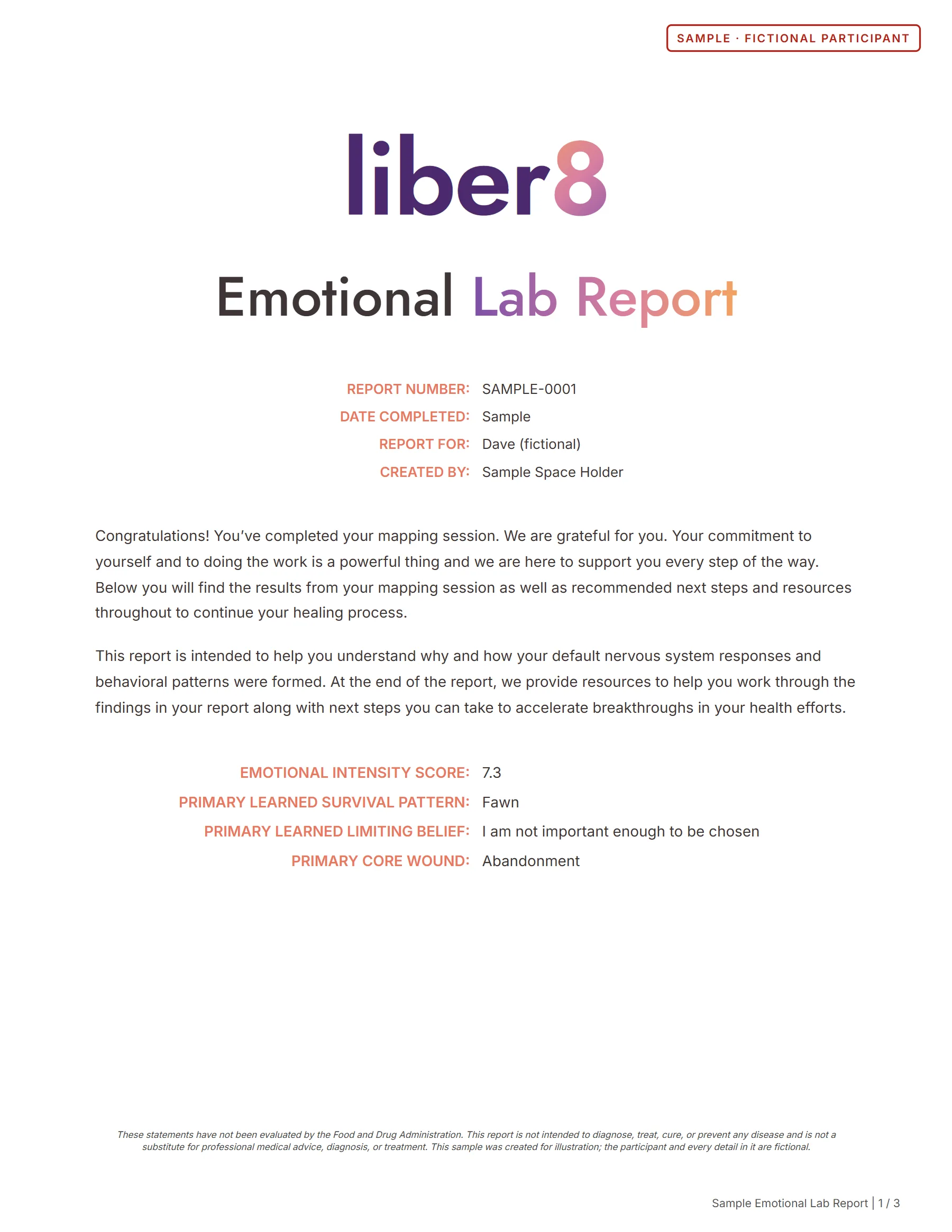
Definition: A client-facing document produced by the system following a Mapping Session. It translates data captured in the Mapping Session into a personalized written report that the individual can read, act on, and return to. The ELR serves as a compassionate therapeutic document, helping the individual understand their own wound structure, and as a precision recommendation tool, prescribing the specific Magic Keys, resources, and practices most appropriate for the individual's current stage in their healing journey.
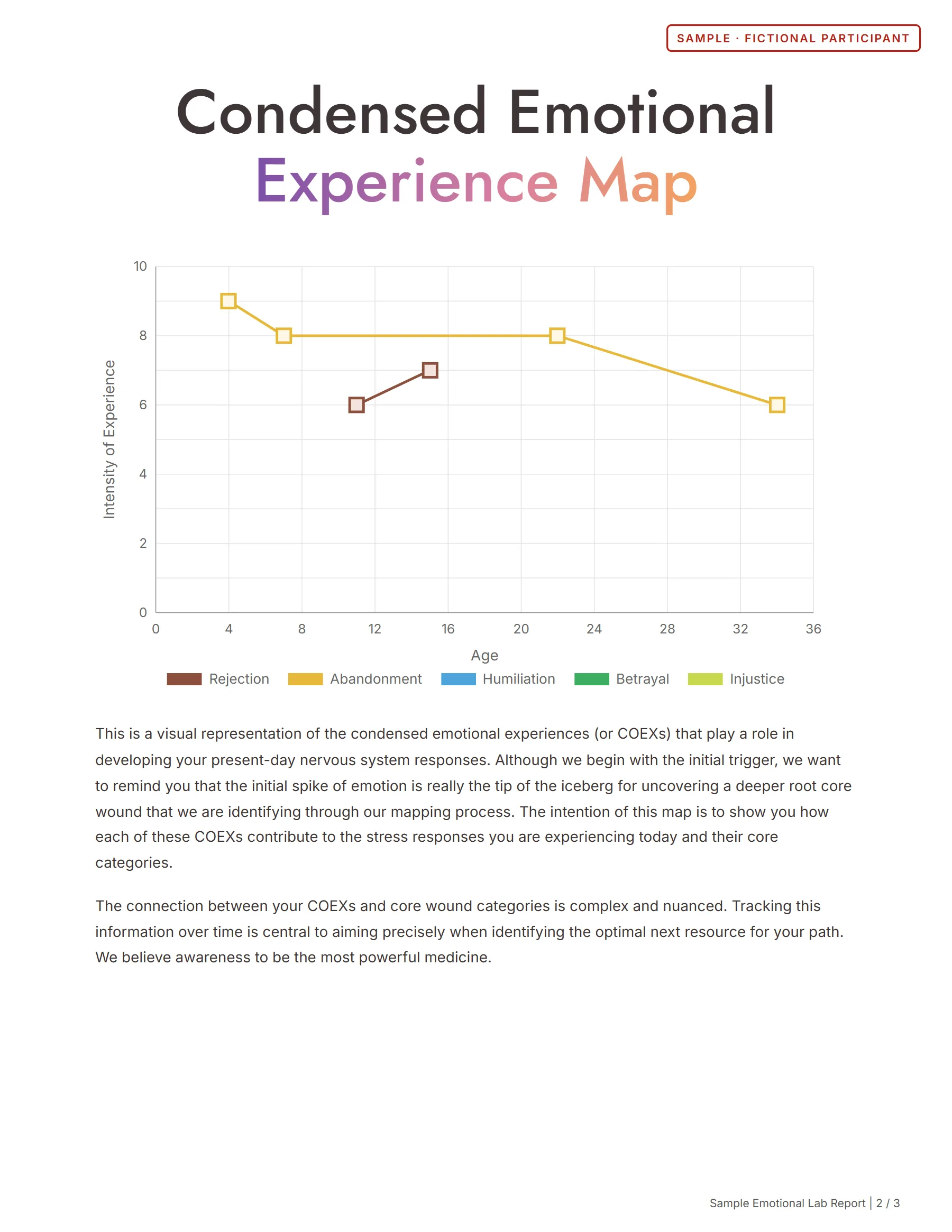
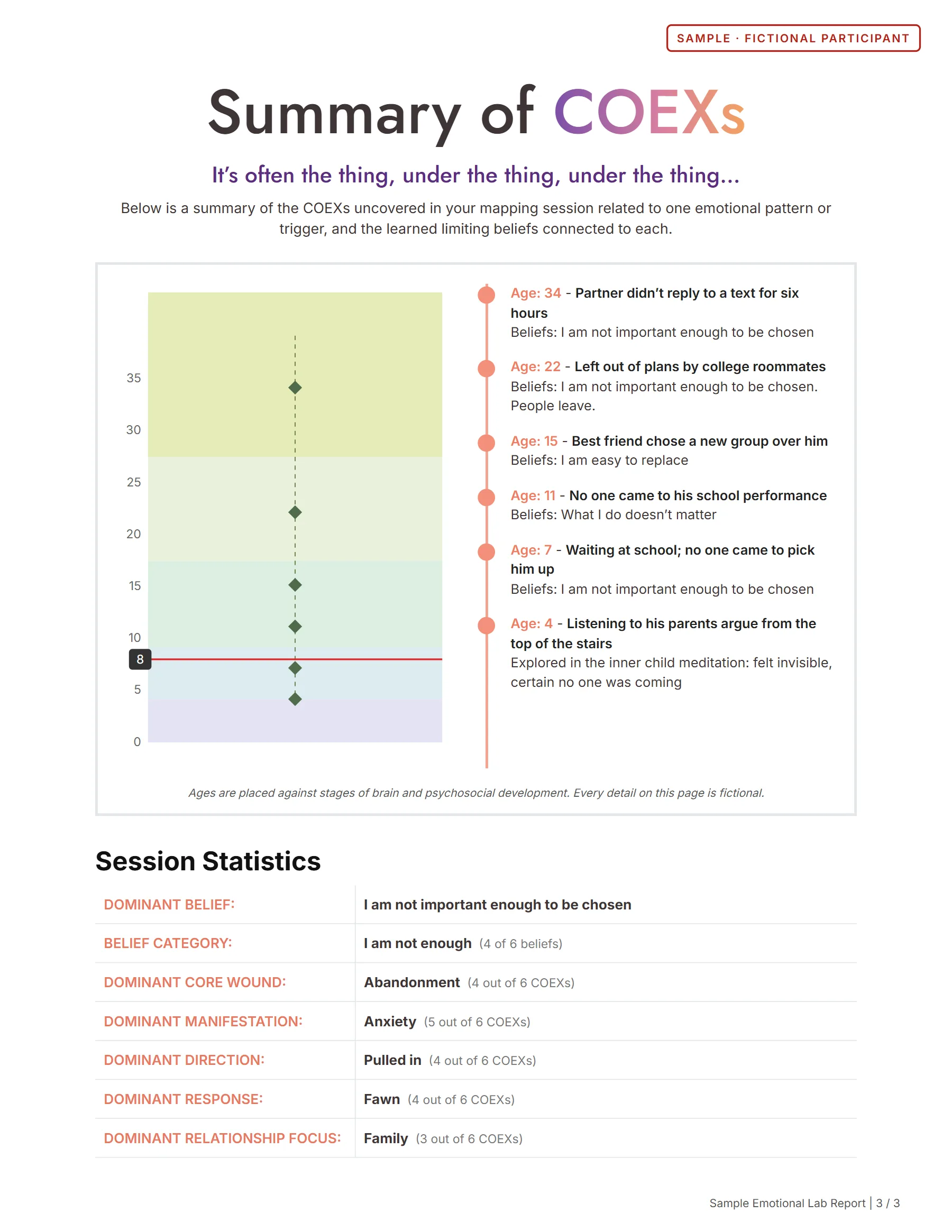
Delivery: The ELR is generated after the space holder completes the Notetaker Upload, typically within 48 hours of the session, and delivered by email or push notification. A separate ELR is generated after each Mapping Session, with each report building on the previous session's data and awareness. Liber8 produced the first working version of the ELR. A sample report from that implementation is included below as a reference for implementing organizations.
Report Components:
| Field | Description |
|---|---|
| Session Summary | A warm narrative overview of what emerged, written to be received rather than analyzed. The individual should feel seen, not clinically assessed. |
| The COEX Map | A chronological display of COEXes from the session, organized from present-day back to the Root COEX, showing age, event, wound category, emotions, body response, and associated LLB for each. |
| Patterns and Trends | Analysis of shared properties across the COEX Stack: recurring wound categories, manifestation patterns, LLBs, and dominant binding sites. |
| Learned Limiting Belief(s) | The specific LLBs identified, named explicitly in the client’s own language. Named clearly and without argument — as the nervous system’s learned conclusions, not objective truths. |
| Session Insights | Presented as seeds, not finished answers. Positive-polarity counterweights to the wound material uncovered. |
| Healing Recommendations | Magic Key assignment(s), resources (books, podcasts, journaling prompts, curriculum), daily practices, and optional practitioner referrals, all matched to the COEX map, binding sites, Healing Phase, and individual profile. |
| Next Steps | Clear action items framed with warmth: continue logging, engage with resources, attend community calls, and (if applicable) schedule the next Mapping Session. |
Example: Within 48 hours of Dave's first Mapping Session, his facilitator completes the Notetaker Upload and the system generates his ELR. Dave receives it by email. Reading it, he sees his abandonment COEX Stack laid out chronologically for the first time, from the age four memory through to the unanswered text that triggered him last month. The report names his LLB in his own words, reflects back the insight he expressed in the session, and prescribes Magic Key 4 with four associated resources. The final section gives him three clear next steps. For the first time, the pattern that has run his relationships makes complete sense to him on paper.
Future Development
This section reflects the Liber8 proof-of-concept implementation and may evolve in future versions of the system. The data objects, fields, and logic described here were tested and validated within the Liber8 program. Implementing organizations should treat this as a reference model. Field names, data types, object relationships, and specific properties may be adapted as the system is built out across new contexts.
Psyche Map
Definition: The cumulative internal data record representing the full known architecture of a single individual's emotional system at any given point in time. It is not a static document but a living structure that grows and deepens as the individual progresses through the system, accumulating data from every Trigger log, Insight log, Mapping Session, community interaction, assessment, and Healing Indicator.
System Role: The Psyche Map is the system's memory of the individual. It captures the full architecture of the wound structure as it is uncovered, tracks how that structure is changing over time, and continuously informs what the system does next to most effectively support transformation. Every data point entered is stored, timestamped, and linked, so the system always knows where this person started, what has surfaced, where they currently are in their healing journey, and which intervention is most appropriate for their next step. It is the data structure that makes personalization possible at scale.
Data Sources Used:
| Source | Description |
|---|---|
| Trigger Log | Ongoing self-reported present-day emotional data |
| Insight Log | Ongoing self-reported positive-polarity awareness data |
| Mapping Session | Deepest structural data entered via the Notetaker Upload |
| Binding Properties | System-derived analysis of dominant binding dimensions across the COEX Stack |
| Community Calls & Live Interactions | Healing indicators captured by the facilitation team or AI-assisted data capture from the calls |
| Healing Indicators Upload | Data entered via Healing Indicators Upload and user engagement as determined by the program |
| Shift Upload | Milestone transformation records linked to specific COEXes and Healing Indicators |
| Possible: Status Updates | Possibility to collect more progress data through an added feature in the user-facing interface |
Example: After three Mapping Sessions, Dave's Psyche Map contains seven COEX records spanning ages four to twenty-two, four linked LLBs, twenty-three logged triggers, eighteen logged insights, and a documented decrease in trigger intensity over the program period. His space holder opens the Progress Display before their next call and can see at a glance that his abandonment stack is collapsing, his anxiety manifestation is reducing, and his engagement with the app has remained consistent. None of this is in the ELR Dave received, it is the internal architecture the facilitation team works from.
How the Data Feeds the Psyche Map:
| Component | Relationship to the Psyche Map |
|---|---|
| Intake Form | Seeds the Identity & Context layer before sessions begin |
| Trigger Log | Continuously adds present-day emotional data |
| Insight Log | Continuously adds positive-polarity awareness data |
| Mapping Session | Adds deepest structural data: COEXes, LLBs, insights, Healing Step updates |
| Notetaker Upload | Data entry mechanism through which session data enters the Map |
| ELR | Client-facing rendering of a curated subset of Map data |
| Recommendation Engine | Reads the Map to generate all intervention prescriptions |
| Healing Indicator Upload | Adds observational progress data from community interactions |
| Shift Upload | Records milestone transformations linked to COEX and healing data |
| Progress Display | Facilitator-facing CRM dashboard view of the Map |
Note for Implementation Teams:
The Psyche Map is the most technically complex component of the system and the hub to which all other data structures connect. All technology implementation must begin with the Map architecture; the schema defining how objects relate to one another is the engineering backbone of the entire system. The current data model reflects architecture tested in the Liber8 implementation and should be treated as a reference model. Field names, object relationships, and properties may be adapted across implementations. The AI-enhanced vision for the Map includes automated COEX extraction from session transcripts, pattern recognition across accumulated data, and AI-generated resource recommendations; dramatically reducing space holder workload and enabling the system to scale.
Recommendation Engine
Definition: The technology layer that translates the individual's full data profile into personalized healing interventions, tools, and resources. It removes guesswork from the facilitation process by matching recommendations to the specific properties of the wound structure, addressing root causes rather than surface symptoms and applying the right tool at the right time.
System Role: The Recommendation Engine (RE) converts the mapping and tracking work into a precision intervention plan. Without it, data sits in the system unused. With it, every session produces a specific, personalized set of next steps. In the current implementation, the RE operates primarily through structured data logic and facilitator input. The AI-enhanced vision involves automated pattern recognition across the full Psyche Map to generate recommendations with minimal manual facilitation input.
Filtering Logic
The Recommendation Engine reads the following data inputs to generate its outputs:
- Current Healing Phase (Acceptance / Gratitude / Responsibility)
- Active Magic Key assignments
- Dominant Binding Site(s) of the COEX Stack (Mind / Body / Heart / Spirit)
- Relationship Layer in which the wound is bound
- Learned Limiting Beliefs associated with the COEX Stack
- COEX Stack properties: core wound category, manifestation pattern, nervous system response type
Output Types:
- Resource recommendations (books, podcasts, journaling prompts, curriculum modules)
- Magic Key assignments
- Daily practices (somatic, mindfulness, awareness-based)
- Practitioner referrals (optional, based on wound structure and available resources)
- Next-step guidance for the individual's program journey
Example: Following Dave's second Mapping Session, the system reads his full data profile: abandonment core wound, heart and body binding sites, Phase 1 to Phase 2 transition, Magic Key 4 assigned, family and partner relationship layers most active. The Recommendation Engine outputs three resources tagged to Magic Key 4, a daily somatic breathwork practice matched to his body binding site, and a suggested referral to a somatic therapist.
Future Development
This section reflects the Liber8 proof-of-concept implementation and may evolve in future versions of the system. The data objects, fields, and logic described here were tested and validated within the Liber8 program. Implementing organizations should treat this as a reference model. Field names, data types, object relationships, and specific properties may be adapted as the system is built out across new contexts.
Categorization Tool: Binding Sites
Definition: The dimension of the human system in which a wound structure is held and living. Matching interventions to the right binding dimension is essential. A wound held primarily in the body will not resolve through cognitive reframing alone. A wound held in the mind will not resolve through somatic work alone. Getting this distinction right is what makes the Recommendation Engine precise and effective.
System Role: Binding Site is a property field of a COEX record and one of the main filters the Recommendation Engine uses to select interventions, alongside Healing Phase and Relationship Layer. A COEX or COEX Stack may involve more than one Binding Site. The system tracks which are most active and sequences tool recommendations accordingly.
Implementation Note:
Binding Site has not yet been formally assigned as a unique standalone data field. Currently it lives as a property within both the COEX record and the LLB, rather than as its own object. The only formal implementation to date has been its connection to the RE as a filtering input.
The Four Binding Sites:
| Site | Description & Recommended Tool Types |
|---|---|
| Mind | Wound held in thought: belief systems, narrative, cognitive patterns, rumination, rationalization. Responds best to perception-shifting tools, cognitive frameworks, books, and Magic Key work. |
| Body | Wound stored somatically: physical tension, chronic pain, nervous system dysregulation, body-based reactivity. Individual may have intellectual insight but the body keeps reacting. Responds best to breathwork, somatic experiencing, movement, and nervous system regulation practices. |
| Heart | Wound held emotionally: unexpressed grief, unfelt anger, withheld love, emotional flooding or cutoff. Individuals may be cognitively aware but emotionally inaccessible. Responds best to emotional expression work, inner child processes, and relational healing. |
| Spirit | Wound has disrupted meaning, purpose, identity, or connection to something larger. May show as existential emptiness, inability to forgive, or collapse of self-worth. Responds best to purpose work, forgiveness practices, legacy statement development, and whole-system expansion tools. |
Example
When triggered, Dave notices three simultaneous signals: tightness in his chest (Body), anxious thoughts about being abandoned (Mind), and an urge to over-text to manage the situation (Heart). These properties are logged into the system and drives the Recommendation Engine accordingly.
Future Development
This section reflects the Liber8 proof-of-concept implementation and may evolve in future versions of the system. The data objects, fields, and logic described here were tested and validated within the Liber8 program. Implementing organizations should treat this as a reference model. Field names, data types, object relationships, and specific properties may be adapted as the system is built out across new contexts.
Notetaker Upload
Definition: The facilitator-facing data entry interface used by a trained Space Holder following a Mapping Session. Its purpose is to translate the raw spoken content of a session into structured data objects in the system, enabling the generation of the Emotional Lab Report and driving personalized resource recommendations from the Recommendation Engine. It is the bridge between the human conversation of the Mapping Session and the data model.
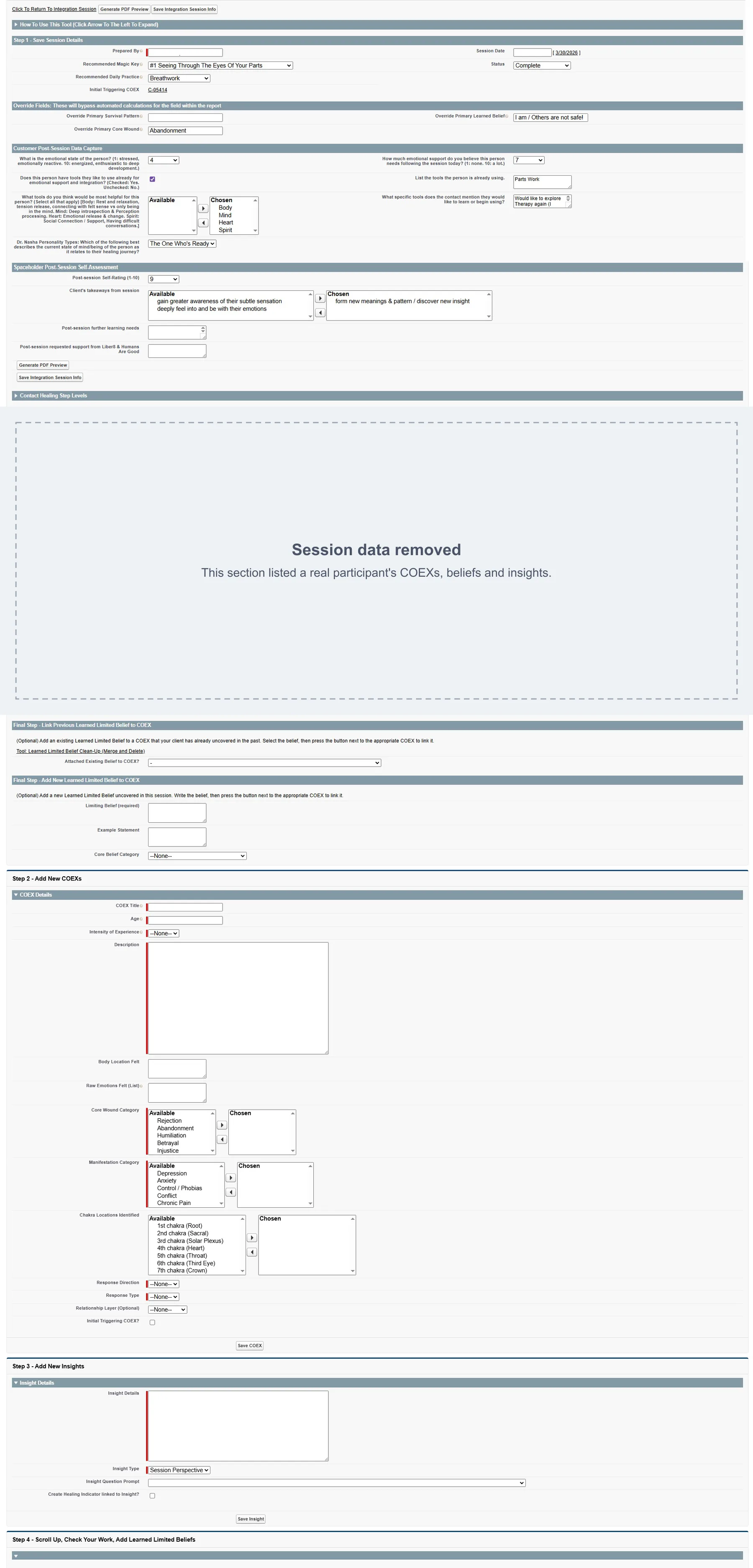
Process: The facilitator completes the Notetaker Upload within 48 hours of the session. Completing this upload is a core certification requirement for Space Holders, and trainees must demonstrate proficiency with the tool before working with clients. The Notetaker can alternatively be adapted to suit an organization's unique niche or approach.
Data Captured:
| Field | Description |
|---|---|
| Session Header | Client lookup, session date, session number (M1/M2/M3), space holder name |
| COEX(s) | One entry per COEX surfaced. A typical session surfaces 3–5. For each COEX there are associated properties to capture (see COEX definition) |
| Insights | Statements of new awareness the client expressed, logged in the client’s own words and typed as Self Truth or Universal Truth |
| Learned Limiting Belief(s) | Captured as linked records associated with specific COEXes; belief category and exact statement as expressed by the client |
| Magic Key Assignment | The Space Holder selects relevant Magic Key(s) based on the COEX map; resources are tagged to these keys |
| Session Notes | Qualitative observations: patterns noticed, what was not said, emotional texture of the session, flags for follow-up |
| Healing Phase | Space holder updates current level |
Where the Data Goes:
- Updates the client's Psyche Map (COEX list, LLB list, Healing Step levels, Magic Key assignments)
- Triggers generation of the Emotional Lab Report
- Feeds the Recommendation Engine
- Populates the client-Facing interface
- Contributes to longitudinal tracking across all sessions
Example: Following Dave's second Mapping Session, his space holder completes the Notetaker Upload within 24 hours. She enters three new COEX records each with their associated properties. She logs two insights Dave expressed during the session, adds a session note flagging that Dave showed signs of emotional suppression when discussing the age fifteen experience, and updates his Healing Phase to Phase 2. Once submitted, the system updates Dave's Psyche Map and begins generating his second ELR.
Future Development
This section reflects the Liber8 proof-of-concept implementation and may evolve in future versions of the system. The data objects, fields, and logic described here were tested and validated within the Liber8 program. Implementing organizations should treat this as a reference model. Field names, data types, object relationships, and specific properties may be adapted as the system is built out across new contexts.
Healing Indicator Upload
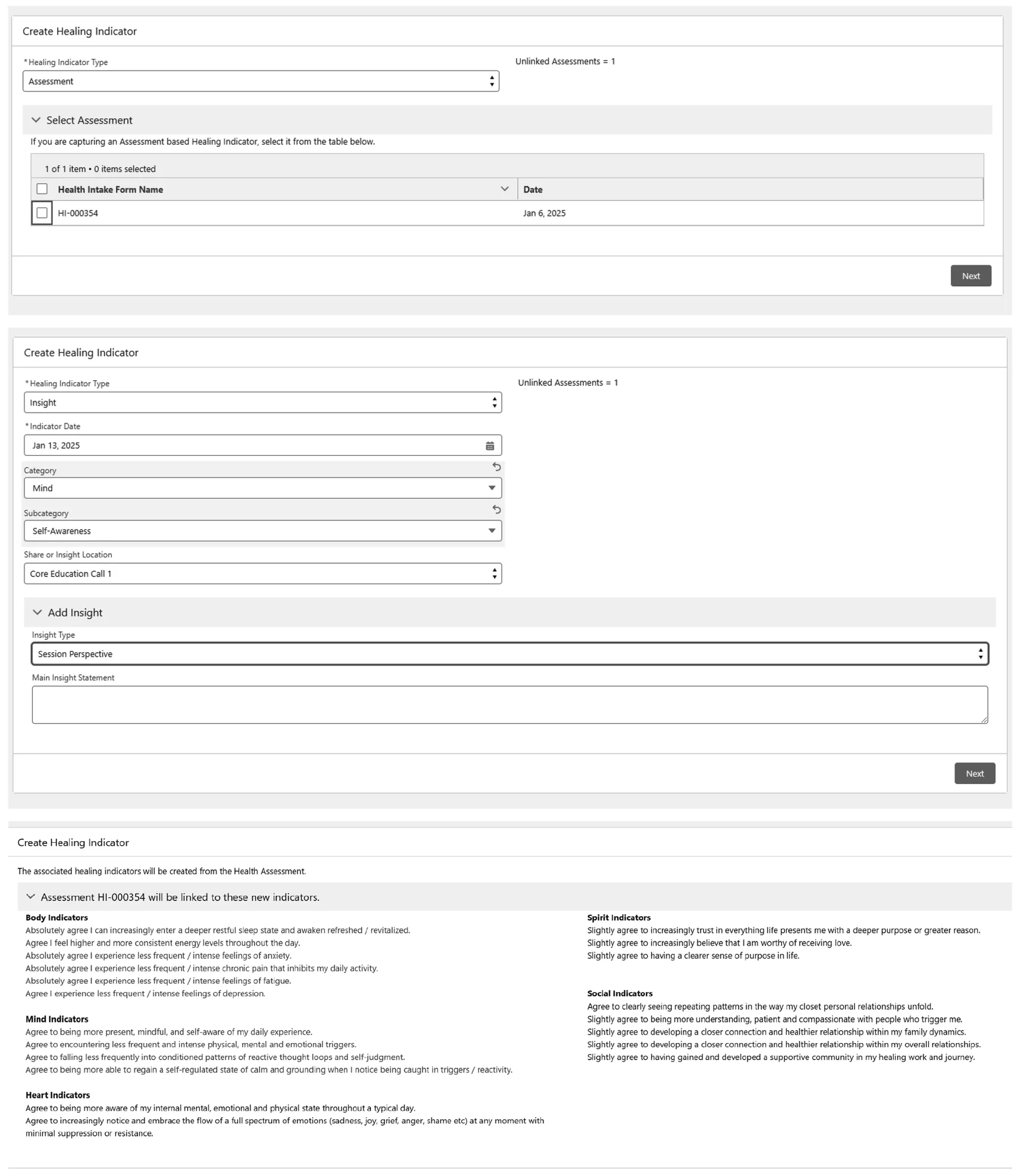
Definition: An interface used by a facilitator (or user-facing AI input system) to log observable signs of progress captured during any interaction with the user (e.g., community calls, 1:1 sessions, self-reported app activity, quizzes, or follow-up prompts). It captures Healing Indicators: notable, observable, categorizable signs that an individual is progressing toward a Shift. They are not the Shift itself; they are the evidence trail that supports documenting it.
Process: Data logged via the Healing Indicator Upload updates the user's Psyche Map, contributes to progress tracking, and provides additional input to the Recommendation Engine. Over time, the accumulation of Healing Indicators across interactions builds the case for a documented Shift, making change visible throughout the system for both the user and facilitator.
Example:
On a community call, Dave shares that he noticed himself feeling calm when a friend cancelled plans last minute, something that would have sent him into a spiral months earlier. His facilitator logs this in the Healing Indicator Upload linked to Dave's abandonment COEX Stack. This single observation joins a growing trail of similar signals that, together, will support the documentation of a Shift.
Implementation Note:
The Healing Indicator Upload was formally designed interface within the Liber8 implementation. Interface specifications exist and the data object is fully defined, but it was not fully built, and full deployment to end users had not occurred. It does appear in the Psyche Map component relationship table as a live data input. Implementing organizations should treat this as a designed but potentially incomplete component requiring build verification.
Shift Upload
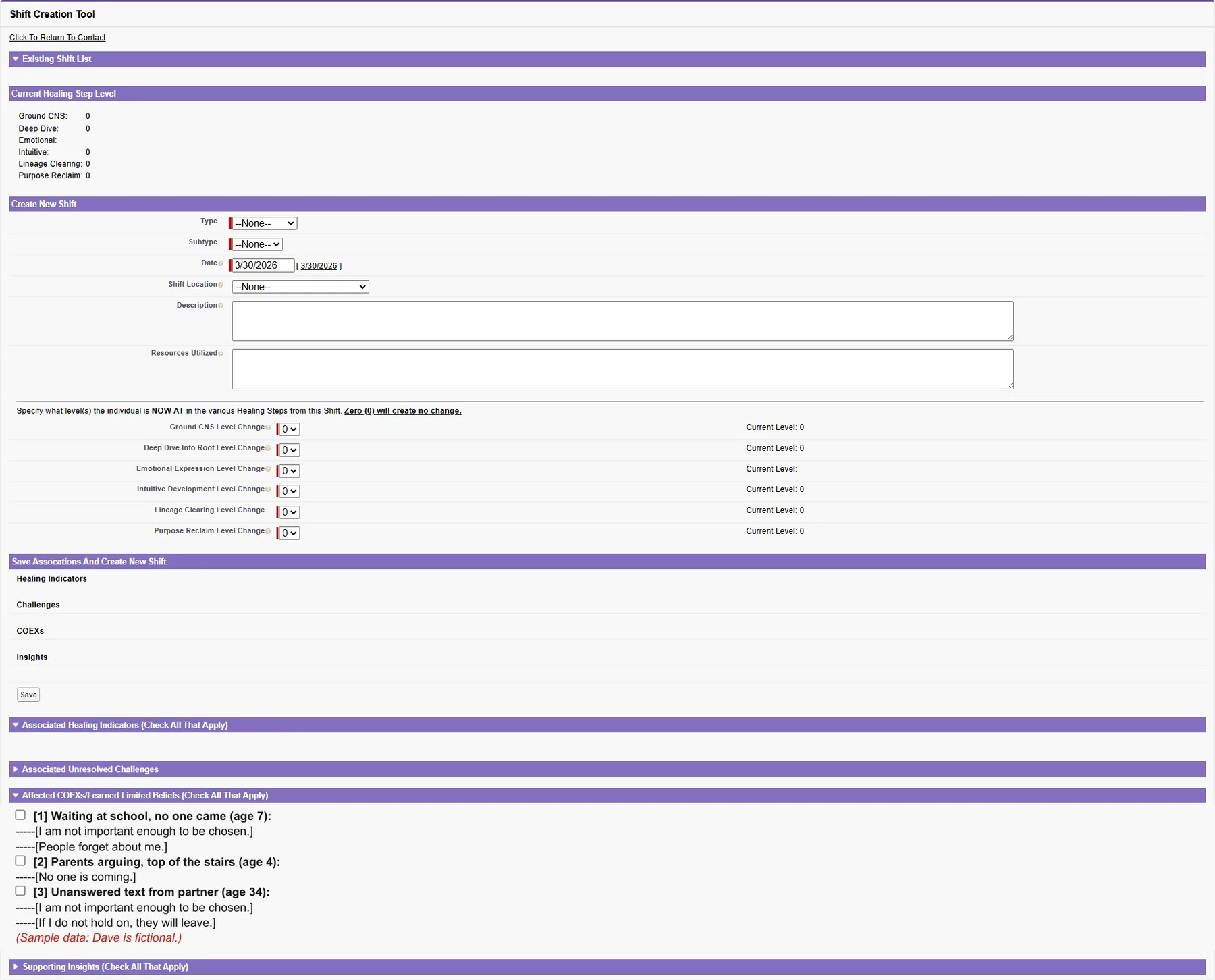
Definition: An interface used by a facilitator (or user-facing AI input system) to document a completed transformation: a clearly observable, definable, sustained change in an individual's way of being. A Shift is a genuine update to the human operating system and a confirmed change in the individual's emotional pattern. Shifts are documented through the accumulation of Healing Indicators and represent the system's highest-level evidence of transformation. A Shift also accompanies a COEX Collapse: the point at which the Trigger(s) of a COEX are no longer activated.
Process: The Shift Upload marks the completion of transformation through a documented COEX Stack and its collapse. When a Shift is recorded, the system links it to the specific COEXes involved, the Healing Indicators that preceded it, and any patterns that remain unresolved. This creates a complete transformation record from the first Trigger log to resolved emotional pattern.
Implementation Note:
The current version of the Shift Upload does not yet include the formal agreements, boundaries, and deal-breaker documentation that completes the Relationship Redefinition process. This feedback loop is identified as a priority for the next iteration of the system.
Example:
Three months into the program, Dave's facilitator reviews his accumulated Healing Indicators and observes a consistent, sustained pattern of change across mind, body, and relational contexts. She opens the Shift Upload, documents what has changed, links the record to the Root COEX, the associated LLBs, the Magic Keys worked with, and the resources utilized. The system updates Dave's Psyche Map. The abandonment COEX Stack that first surfaced as a trigger about an unanswered text is recorded as collapsed.
Relationship Redefinition Exercise
Definition: A structured writing exercise initiated when an individual has moved through the Acceptance and Gratitude Healing Phases and is actively in the responsibility/embody phase, with sufficient Healing Indicators to indicate readiness. The individual articulates new agreements, boundaries, and deal-Breakers in relation to the wound structure being healed, then writes a Legacy Statement declaring who they are choosing to become.
Delivery: Each element is expressed in the individual's own words, in the positive, in first person. The exercise is not introduced prematurely; it is most effective when the individual is genuinely enacting the Healing Phases and is actively in the responsibility phase, not merely understanding it. It can be delivered through group calls, 1:1 sessions, self-directed journaling prompted by the app, or AI-assisted writing prompts within the platform. For couples or relational programs, the Agreements component may be co-written between both parties as part of a shared healing process. For individual programs, agreements are typically self-directed.
System Role: The Relationship Redefinition Writing Exercise is the bridge between intellectual understanding and embodied identity change. Without it, healing can stall at insight: the individual grasps what happened and may feel genuine relief, but the new truth has not yet restructured how they live and relate to others. This exercise completes that integration step by anchoring insight into declared behavior, language, and identity. The Recommendation Engine surfaces the exercise prompt when Phase 3 readiness is detected through accumulated Healing Indicator and Trigger log data. It is the process that produces the Legacy Statement.
This exercise redefines the relationship to a COEX or COEX Stack from the healed side. The language the individual uses must emerge from their own voice and not be assigned. The system stores completed elements as Healing Indicators linked to the relevant COEX Stack, contributing to Shift documentation and COEX Collapse tracking.
The Four Components
1. Agreements
Mutual commitments (most commonly written within relational or partnership contexts) that define how two people agree to show up for each other. Agreements address the relational dynamic directly and are co-created rather than unilaterally declared. In individual programs, Agreements may also be self-directed: commitments the individual makes to themselves about how they will operate going forward.
Example: "We are each other's safe place. We always respond with kindness, even when it's hard."
2. Boundaries
Boundaries define what the individual is committed to protecting and cultivating; the conditions required for their own health, growth, and integrity. In How To Human, boundaries are framed not primarily as what is kept out, but as what is kept in and protected. This framing prevents boundaries from becoming defensive walls and instead positions them as active expressions of self-respect and self-knowledge. Boundaries name specific behaviors, dynamics, or conditions that the individual will no longer accept or participate in. They are stated clearly, in their own language, without justification or apology.
Example: "I do not accept harsh or demeaning communication in my relationships. I will remove myself from these situations."
3. Deal-Breakers
Deal-Breakers are non-negotiable conditions; the lines that, if crossed, change the nature of the relationship entirely. They are typically written as extensions of Boundaries. A Deal-Breaker defines what ends or fundamentally alters a relational dynamic. They are not threats; they are honest declarations of where the individual's self-respect requires them to act. Deal-Breakers are written sparingly and only where genuinely true. They carry weight because they represent the individual's deepest commitments to their own integrity.
Example: "Repeatedly dismissing or invalidating my expressed boundaries is a deal-breaker for me in any relationship."
The Legacy Statement emerges directly from this exercise as its output: the individual's self-authored declaration of who they are choosing to be, arising from the wound that has been healed. See the full definition and system role here.
Example: "I am someone who stays present, asks for what I need, and trusts that love does not require me to disappear."
| Connected Element | Relationship |
|---|---|
| Healing Phase: Responsibility | This exercise is the primary deliverable of Phase 3 (Embody). It signals that the phase is being enacted, not merely understood. |
| COEX Stack | Each exercise is linked to the specific COEX or COEX Stack being resolved. |
| Legacy Statement (5.4) | Emerges as the final output of the exercise and is stored separately in the Psyche Map. |
| Healing Indicators | Completed Boundaries, Agreements, Deal-Breakers, and Legacy Statements are logged as Healing Indicators under the Social category. |
| Shift / COEX Collapse (5.2) | A completed Relationship Redefinition exercise is strong evidence of Shift and may contribute directly to COEX Collapse documentation. |
| Recommendation Engine | Surfaces the exercise prompt when Phase 3 readiness is detected through accumulated Healing Indicator and trigger log data. |
Example:
As Dave's abandonment COEX Stack begins to collapse, his facilitator introduces the Relationship Redefinition Writing Exercise. Dave writes a Boundary: "I do not remain in relationships where my expressed needs are consistently dismissed." A Deal-Breaker: "Repeated emotional withdrawal without acknowledgment is a deal-breaker for me." And a Legacy Statement: "I am someone who stays present, asks for what I need, and trusts that love does not require me to disappear." Each element is logged in the system, linked to the COEX Stack, and recorded as a Healing Indicator. His facilitator documents a Shift.
Implementation Note:
The written outputs of this exercise (Agreements, Boundaries, Deal-Breakers, and the Legacy Statement) are not yet captured as dedicated structured data fields in the system. In the current build, these are logged as unstructured text within the Shift description field or manually recorded as Healing Indicators by the facilitator. A priority for the next iteration of the system will be to develop the Description field into further phase categorization and connect these outputs directly to the relevant COEX Stack and Shift records. Until that build is complete, implementing organizations should establish a clear facilitation protocol for capturing and linking these outputs consistently.
Morning Practice
Definition: A dedicated window of time in which the individual intentionally connects with their current insights and active life intentions. The individual is to feel them, embody them as best as they can in this practice. The specific form (meditation, journaling, movement, reading, breathwork) is left to the individual, and not a prescribed method. What defines it is the quality of attention and energy brought to it, not the activity itself.
Purpose: The Morning Practice acts like a daily compass; keeping the insights and intentions being developed through the program in active awareness rather than allowing them to drift between sessions. This is to also help prevent the individual from entering their day in a reactive mode, where their patterns run the show.
Implementation Note:
The Morning Practice is documented in Space Holder training materials. It is intentionally unstructured. Facilitators introduce it as a daily habit, not a technique.
Liber8: Proof of Concept
Overview of Liber8
The How to Human system was built, tested, and refined through a live implementation called Liber8: a three-month emotional healing program applying the data model, facilitation method, and tracking infrastructure with oncology patients. Liber8 is the proof of concept, and the experimentation ground in which its most important design decisions were made, and validated against real participants in a demanding clinical context. The program showed that the model can be run end to end with real participants.
Liber8 is not a finished study. It is a documented proof of concept with a tested facilitation methodology and a participant cohort whose transformation arcs are partially captured in the system.
Who Liber8 was. Liber8 was a separate company, co-founded by Raj Jana, that built a program on the How to Human model. The Humans Are Good Foundation, a nonprofit, is the home of the model itself; Liber8 implemented it in its own way and in its own commercial language. Liber8 began after Raj watched a friend with stage four cancer, Tristin Roney, trace his shame and fear back to their roots in the last months of his life, and asked what might have been possible if inner healing had been part of his care from diagnosis. Between 2021 and 2023, Liber8 developed its program for people navigating cancer and chronic dis-ease in collaboration with the Humans Are Good Foundation, Dr. Nasha Winters and the Metabolic Terrain Institute of Health. Between 2023 and 2026 it guided more than 500 people through the method in multiple cohorts, before retiring liber8.health and moving its services to Liberate.Love.[38]
The White Paper
Before running participants through the program, Liber8 established the scientific case for why addressing emotional distress should produce measurable changes in physical health. The resulting white paper, The Impact of Emotional Health on Physical Wellbeing, documented the peer-reviewed evidence across psychoneuroimmunology, epigenetics, trauma neurobiology, and psycho-oncology.[1]
The core argument: the current medical treatment paradigm focuses almost entirely on physical symptom reduction, while emerging research consistently demonstrates that emotional and physical health are causally intertwined. Toxic stress, unresolved emotional charge, and adverse childhood experiences are documented contributors to immune dysregulation, inflammatory states, and reduced treatment adherence, and adverse childhood experiences are linked to higher rates of chronic disease, including cancer.[39] The gap in the system is the inability to quantify, track, and systematically address the emotional dimension of a person's health picture. How to Human is designed to fill that gap.
Program Design
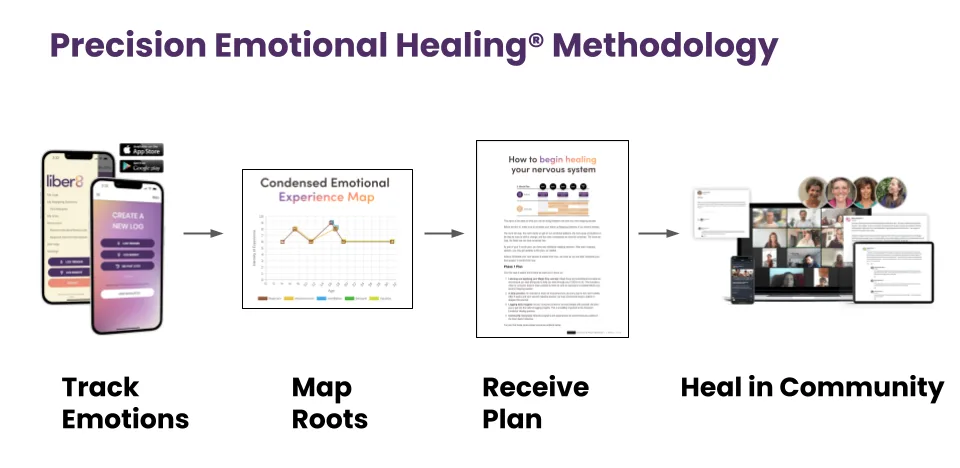
Liber8 ran as a structured three-month program organized across three planned semesters, each designed to progressively expand the individual's capacity to be seen in increasingly wider relational contexts. This was a design principle directly informed by the Relationship Layer architecture of the How to Human model.
In practice, only Semester 1 (three months) was fully executed. Semesters 2 and 3 exist in the design documentation and were only partially executed. They represent the intended long-form trajectory of the program. The full three-semester arc remains a possible design vision for future implementations.
The Intended 12-Month Program Structure
Throughout the program, the How to Human data loop was active. Participants logged triggers and insights continuously. Mapping Sessions produced COEX data records. Healing Indicators were captured from community calls, 1:1 interactions, and app activity. Health assessments were administered at intake and at defined intervals, measuring outcomes across physical, mental, emotional, spiritual, and social wellness. The infrastructure for tracking the full arc from first trigger log to COEX Collapse was built and tested within this program.
| Semester | Duration | Relational Layer | What Happened |
|---|---|---|---|
| Semester 1 | 3 months | 1:1 with trained facilitator | Participant is witnessed by a trusted professional; COEX identification begins; foundational education introduced |
| Semester 2 | 6 months | Peer group with facilitator | Reciprocal witnessing in a facilitated group; personal journey experience attended and integrated |
| Semester 3 | 3 months | 1:1 with paired peer at a similar stage | Deep one-on-one mutual accountability and transparency; sustained integration |
Semester 1: Professional Mapping Sessions (fully executed, 3 months)
The focus of Semester 1 was the individual being witnessed by one trained professional, often for the first time at this level of intimacy. Over 12 weeks, participants were onboarded through the app, completed three Mapping Sessions, received their Emotional Lab Reports, and engaged with core educational content and resources.
Three Magic Keys were introduced as the shared perceptual framework for all participants rather than through individualized Recommendation Engine assignment:
- Magic Key: seeing through the eyes of the other
- Magic Key: seeing through the eyes of your parts
- Magic Key: seeing through the eyes of divine love, unity, and oneness
Psychological safety was the foundational operational requirement throughout. This was the semester fully executed in the Liber8 proof-of-concept program.
Semester 2: Buddy Groups (designed, partially executed)
Semester 2 was designed as a six-month expansion of the relational container; moving from being witnessed by one professional to being witnessed reciprocally within a peer group. The design included two Buddy Groups facilitated by trained space holders, a Personal Journey Experience (a first-time immersive growth experience the participant chooses, such as a personal development seminar like Landmark, or a meditation or yoga retreat) selected from approved third-party modalities, a structured community share upon return, and introductory Space Holder training enabling participants to hold space for each other. Buddy Groups were partially piloted within Liber8; the full semester design was not completed within the proof-of-concept program.
Semester 3: Journey Mates (piloted informally)
Semester 3 was designed as a three-month initiation into the Journey Mates structure: a deep one-on-one pairing between two participants at similar stages of their process. The focus was mutual witnessing, accountability, and integration as the mechanism for sustained integration. It was described as the equivalent of a childhood best friend relationship in terms of depth of safety and openness. As a formal semester it was never run. Journey Mate pairings were piloted within Liber8 and also emerged informally out of the Buddy Groups; the formal structure remains the design vision for the long-form implementation.
Implementation Note:
The Liber8 project produced the first version of every tool described in this wiki: the Notetaker Upload, the Healing Indicator Upload, the Shift Upload, the Progress Display, and the ELR. Every design decision in the current data model reflects something that was tested, adjusted, or identified as a limitation during the Liber8 program. Implementation teams building on this model are building on a system that has already been run, refined, and validated in a live context.
Evidence and Outcomes
What It Demonstrated
Liber8 tested the model end to end.
The system’s stages (track → map → recommend → heal → integrate → repeat) functioned as designed. The data model captured the transformation arc from presenting trigger to resolved pattern in a way that had not previously existed in any personal development program.
Relational witnessing is the most important healing mechanism.
The most significant design insight from Liber8 was how reliably transformation deepened at each successive relational layer. Being seen by one professional produced one quality of shift. Being seen by a peer group (Buddy Group) produced another. Being seen by an intimate friend (Journey Mate), in the informal pairings that grew out of the Buddy Groups, produced another still. The program works because of its relationality. Awareness increases and perspectives shift when a person is witnessed. This is not incidental to the design; it is the design. [43]
Structured emotional awareness work produces observable cross-domain changes.
Applying the system within an oncology population (one of the most demanding human contexts) produced self-reported improvements across physical, mental, emotional, social, and spiritual health within 90 days.[44] The outcome data is in the Evidence section below.
Results
Over its run, Liber8 took more than 500 people through its three-month program, across multiple cohorts.[38] The figures below come from specific cohorts, all of them people in or after cancer care, and should be read as pilot results.
| Cohort | Who | Enrolled | Completed the post-program measures | Source |
|---|---|---|---|---|
| Quality of Life program | 95% in active cancer care, referred by a doctor or cancer advocate | Not stated ("small sample size") | Not stated | [44] |
| Breast cancer cohort | Stage 3/4 active to survivor; 90% in active treatment | 70 | About 25% (roughly 18 people) | [43] |
| 90-day case study | Cancer patients | 30 | 69% completed month 2; 33% (about 10 people) completed month 3 | [43] |
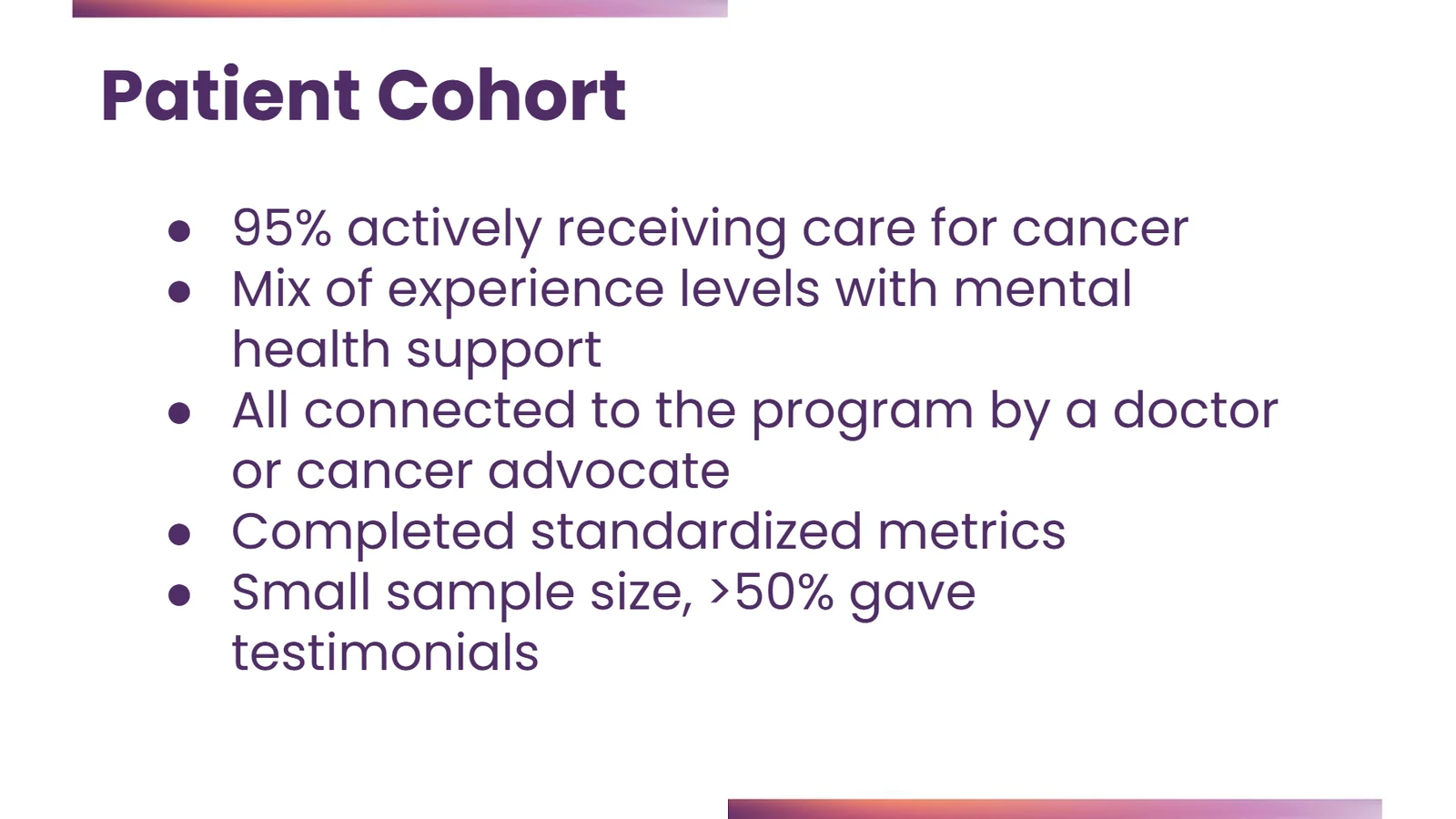
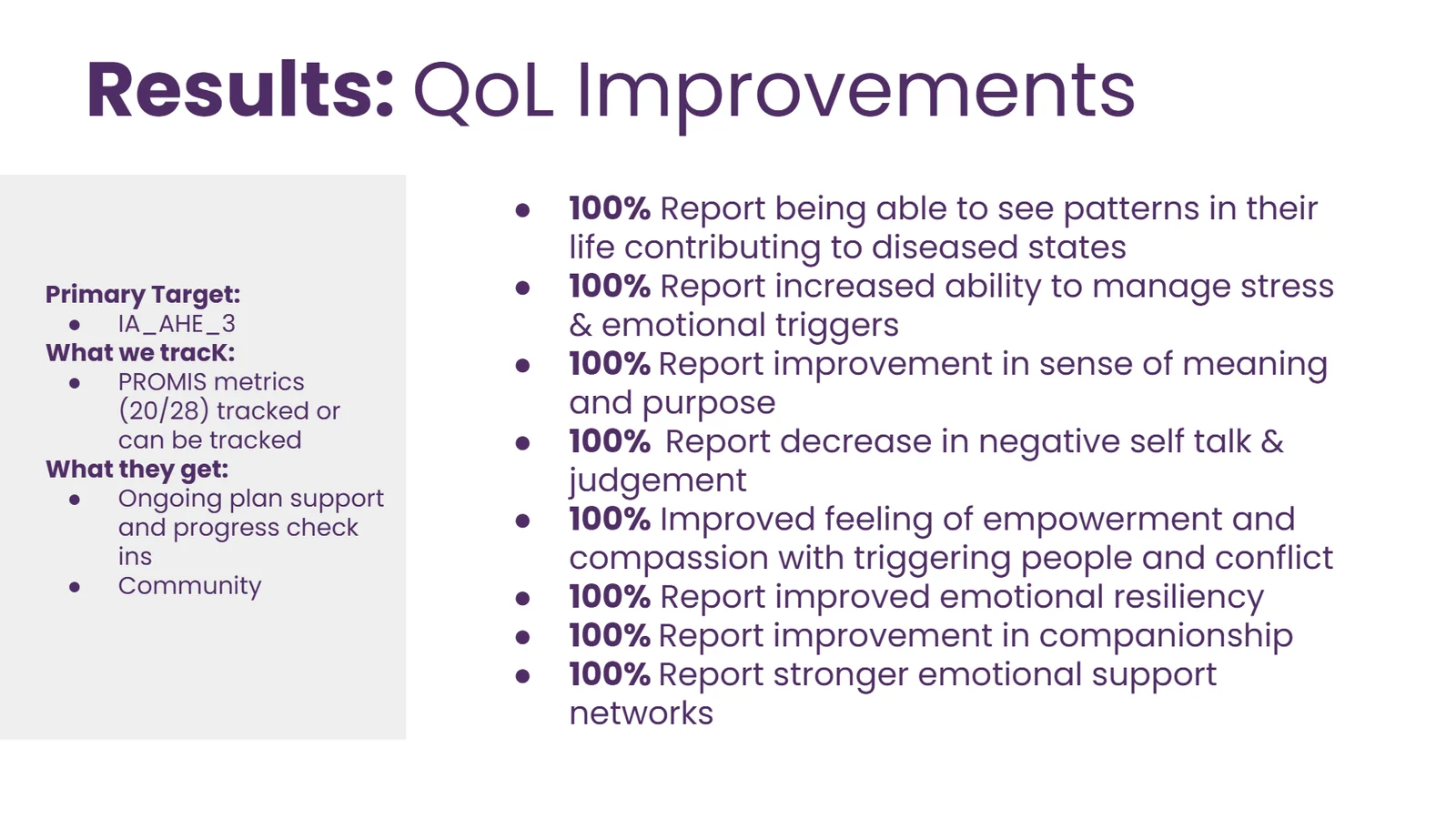
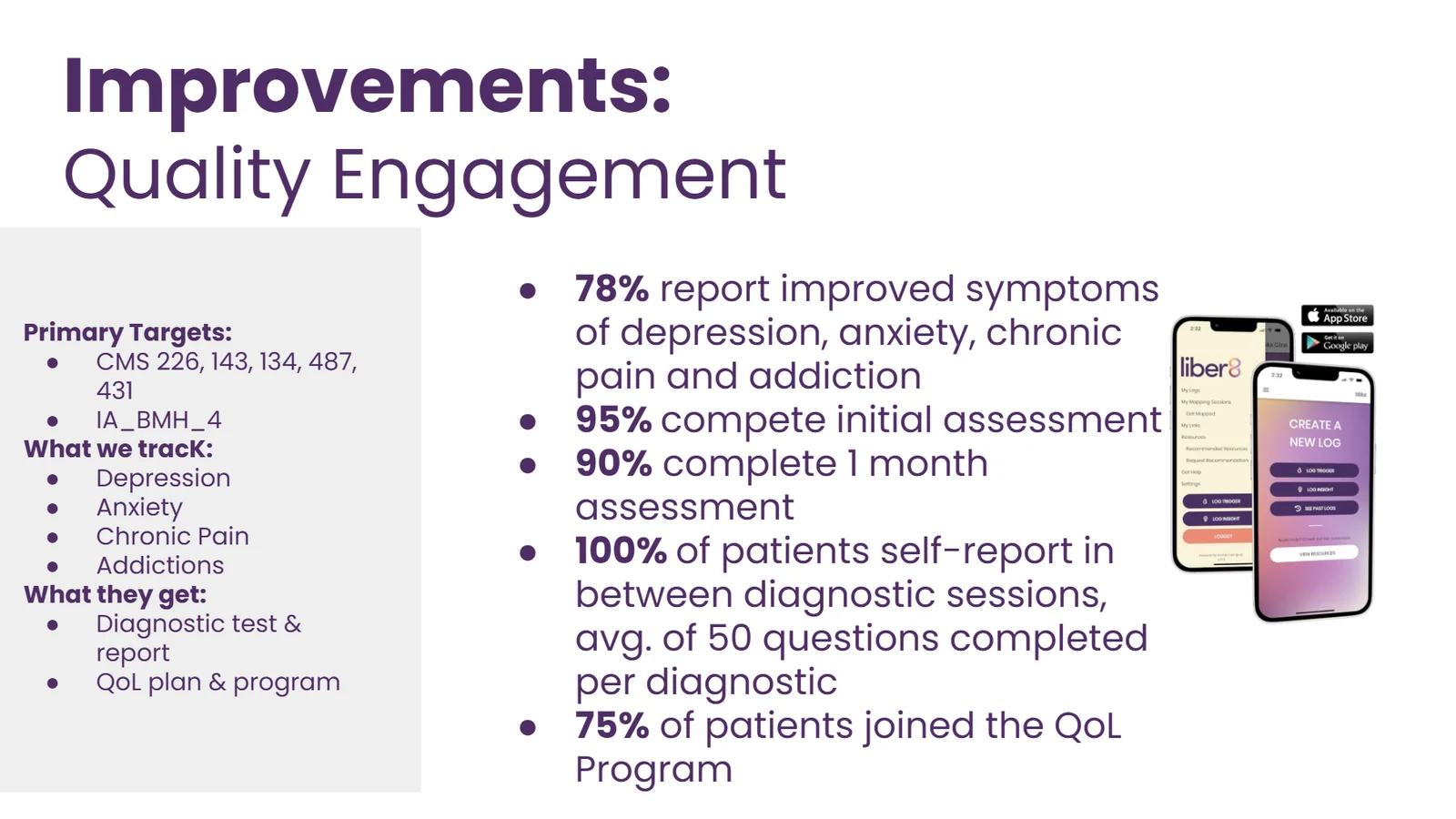
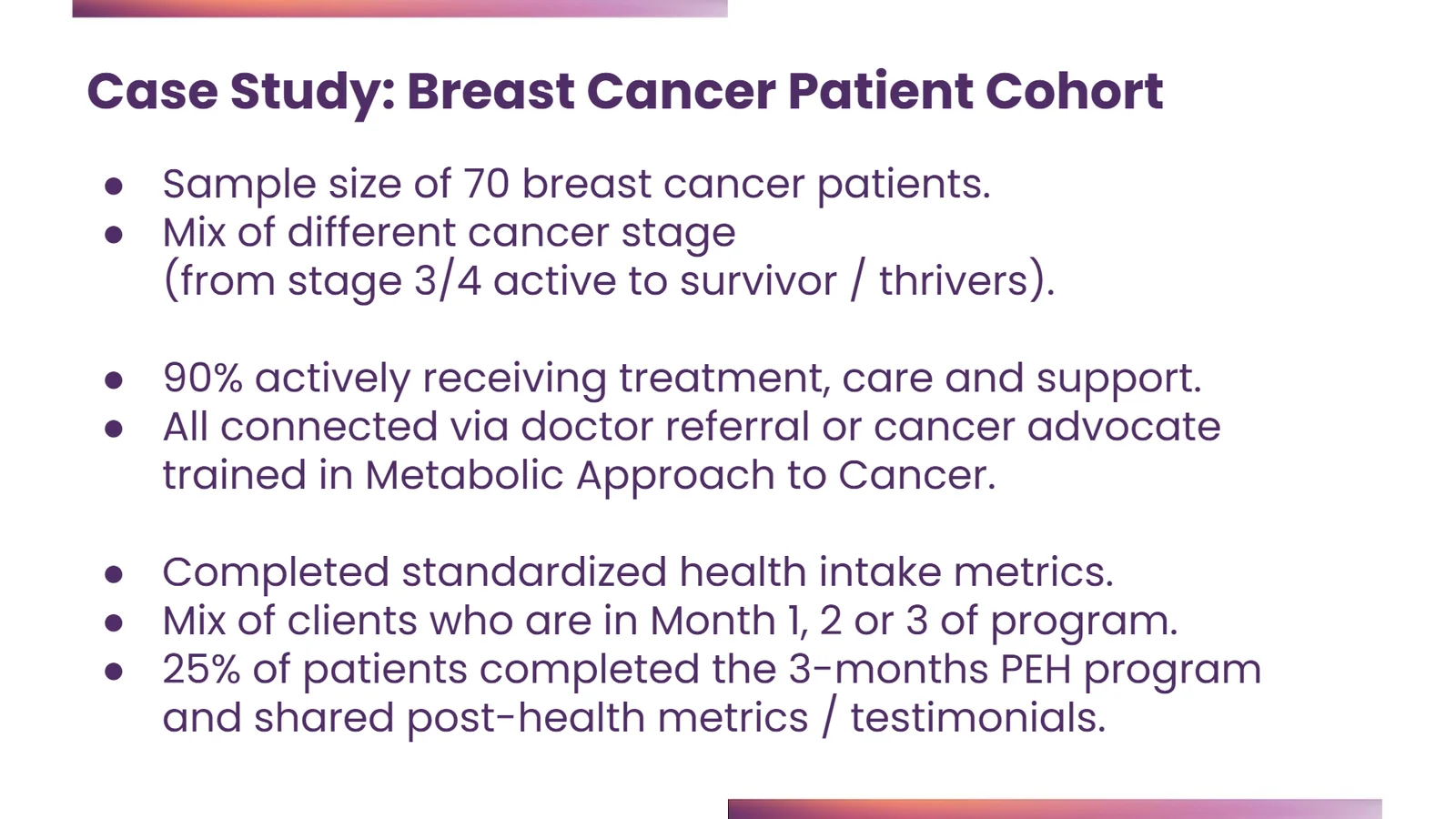
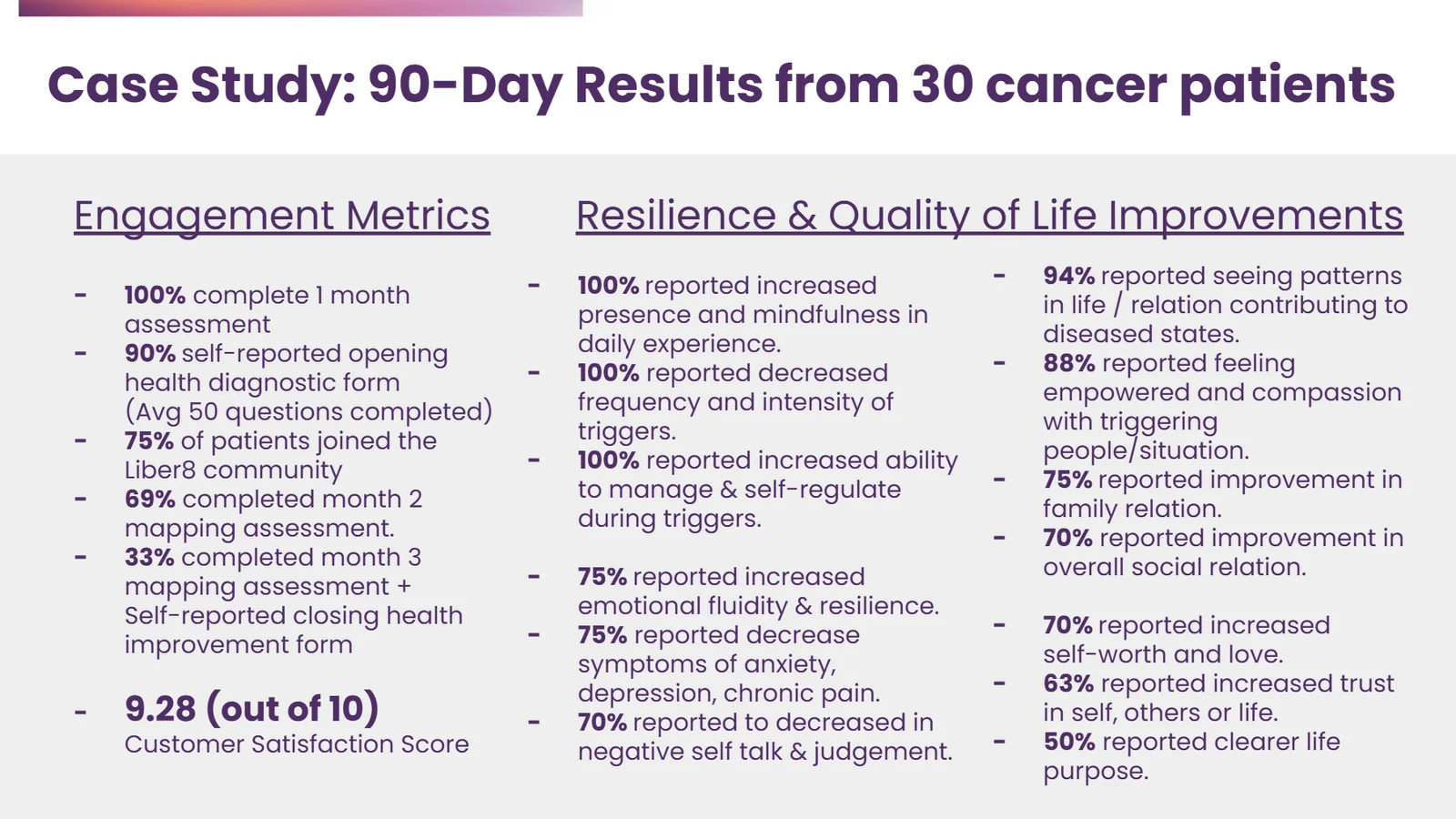
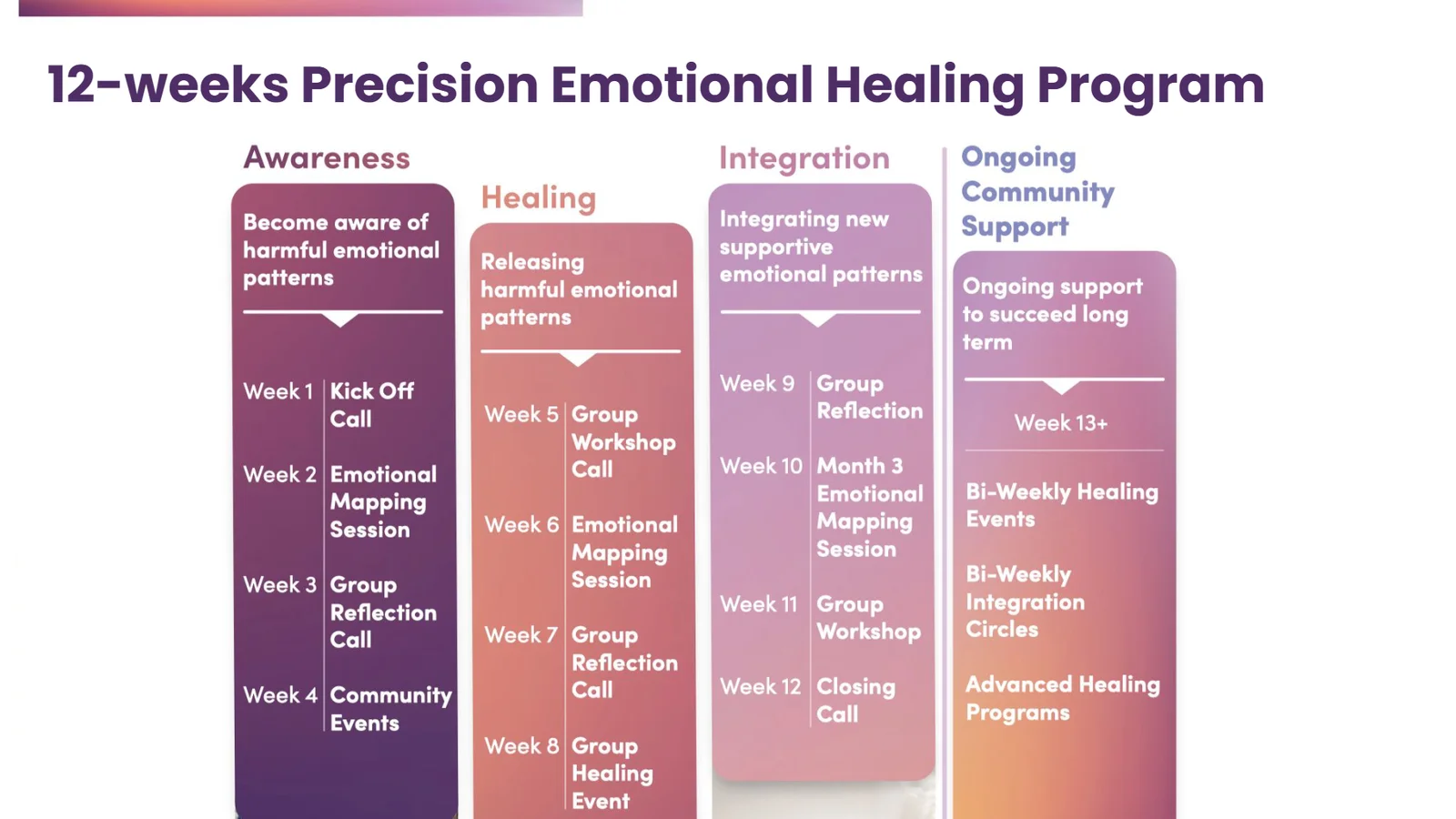
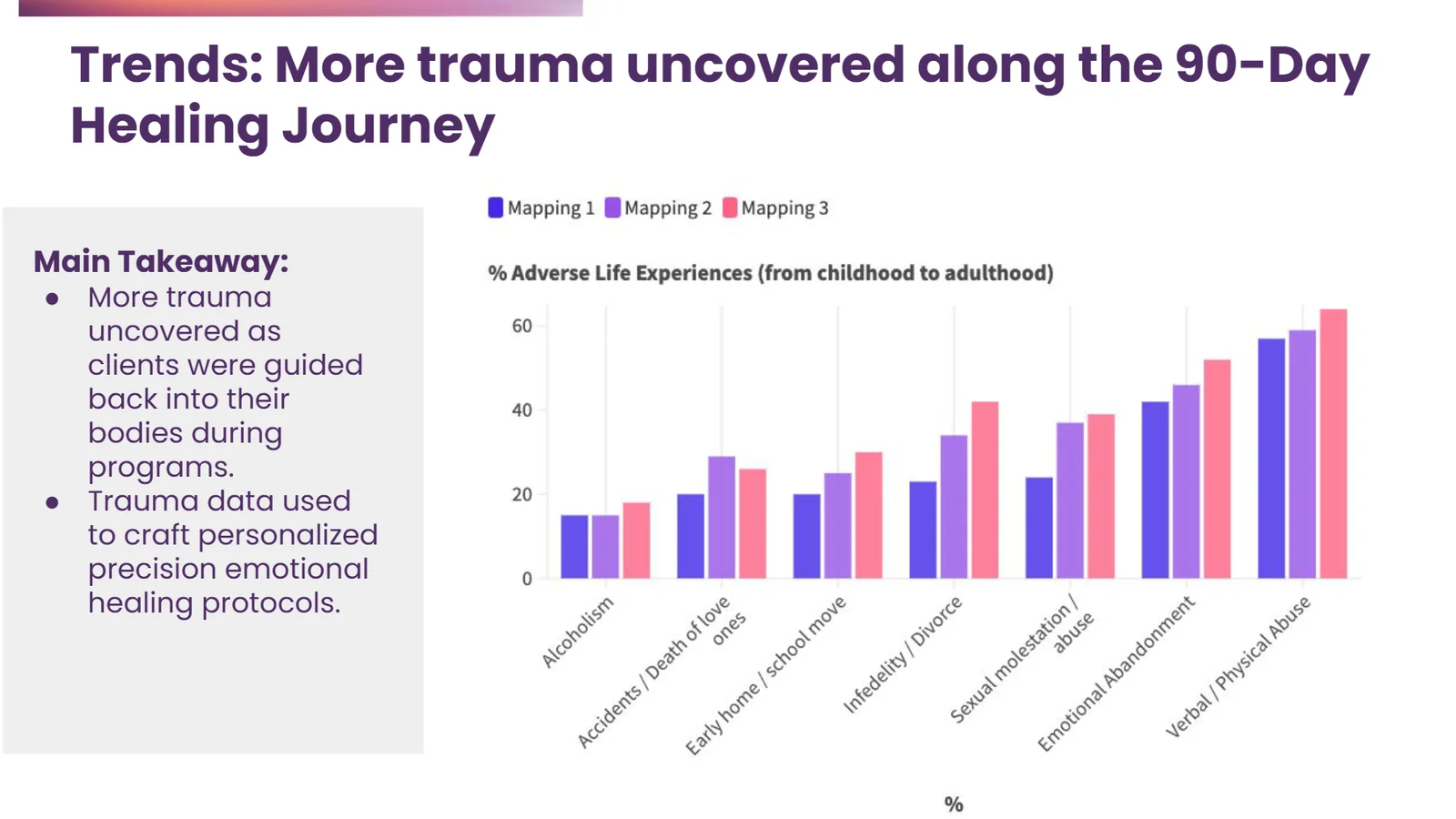
Both cohorts used the same core system: health assessments at intake and defined intervals, continuous self-reporting through the app, and structured tracking across physical, mental, emotional, spiritual, and social domains. [43]
Clinical Symptom Improvements
In the Quality of Life cohort, 78% of participants reported improved symptoms of depression, anxiety, chronic pain, and addiction.[44]
Quality of Life Outcomes
The QoL cohort showed 100% self-reported improvement across eight domains:[44]
- recognizing life patterns contributing to dis-ease [44]
- ability to manage stress and emotional triggers [44]
- sense of meaning and purpose [44]
- reduction in negative self-talk and self-judgment [44]
- empowerment and compassion toward triggering people and situations [44]
- emotional resilience [44]
- sense of companionship [44]
- strength of emotional support networks [44]
These are not incremental improvements. Across every one of these domains, every participant in the cohort reported a positive shift. This consistency points to something structural in the methodology rather than individual variation in response.
Cancer Patient Case Study
Emotional Regulation
In the area of emotional regulation, 100% of participants reported increased presence and mindfulness, decreased trigger frequency and intensity, and improved ability to self-regulate during triggering events. Three quarters reported increased emotional resilience and decreased symptoms of anxiety, depression, and chronic pain. Seventy percent reported reduced negative self-talk and self-judgment.[43]
Self and Relational Health
- 94% reported being able to see patterns in their life and relationships contributing to their dis-ease (the survey item read "diseased states") [43]
- 88% felt empowered and compassionate toward triggering people and situations [43]
- 75% percent reported improved family relationships [43]
- 70% reported broader improvement in social relationships [43]
- 70% percent reported increased self-worth and self-love [43]
- 63% reported increased trust in themselves, others, or life [43]
- 50% reported greater clarity of life purpose [43]
Qualitative Data: What Participants Said
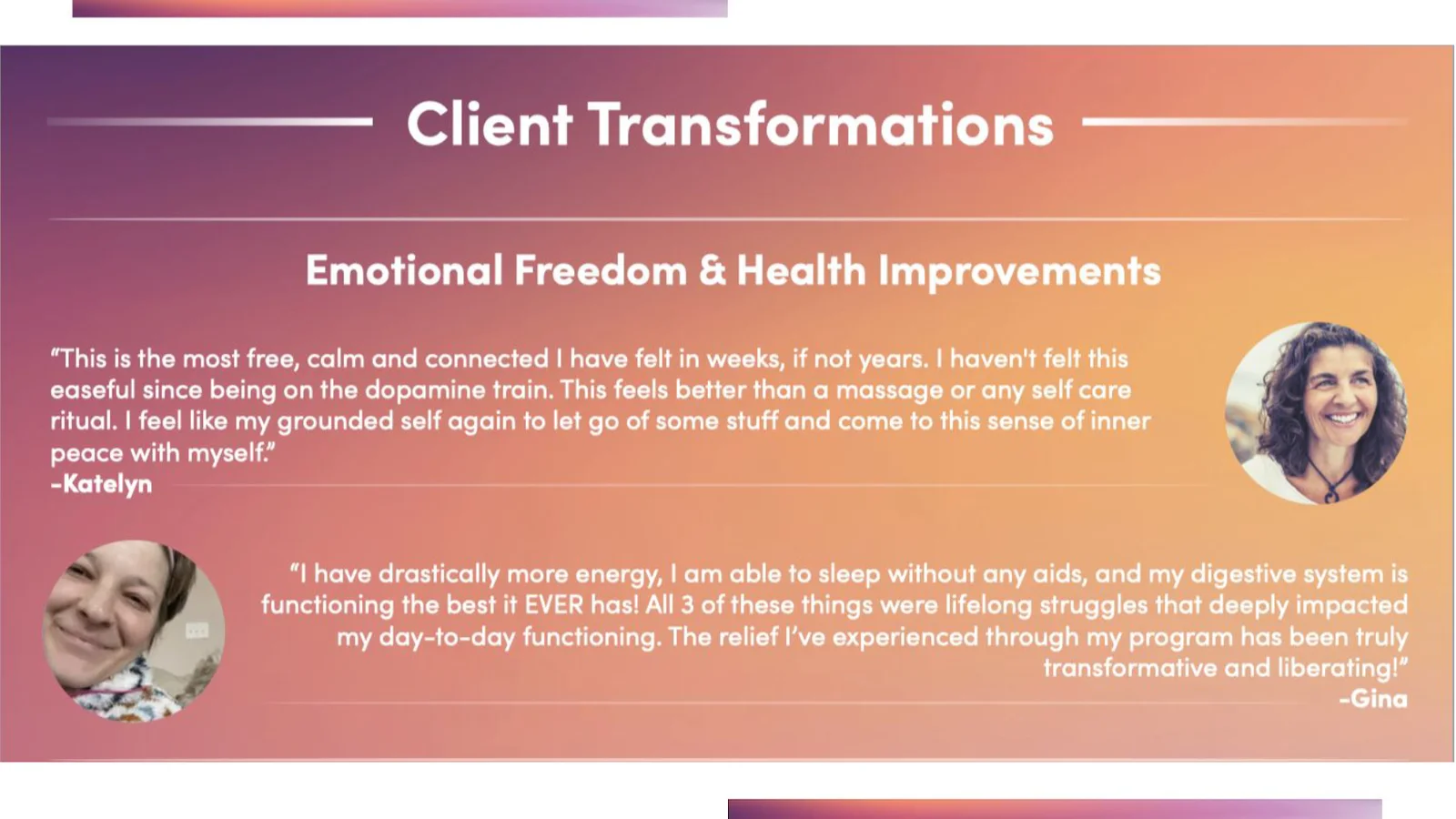
The quantitative data is consistent with what participants described in their own words. Themes that appear repeatedly across testimonials include: a new ability to observe and regulate emotional triggers rather than be controlled by them; improved physical symptoms (energy, sleep, digestion) as a direct result of emotional work; a shift from seeking love and validation externally to finding it internally; reduced judgment toward family members who had caused harm; and a changed texture to daily life — slower, more present, more considered. These qualitative shifts align precisely with what the system is designed to produce: not symptom management, but a genuine update to the patterns driving behavior and experience.
Facilitation & Program Delivery Guide
The Space Holder
Definition:
A trained facilitator who creates and maintains the psychologically safe container required for a Mapping Session or group session. The space holder's role is not to heal, fix, advise, or interpret. It is to witness, hold, and guide the structured question process that allows the individual to surface their own material. The space holder is the human expression of the system's witnessing architecture. A space holder is not a therapist, counselor, or crisis worker. They are not responsible for clinical assessment, diagnosis, or treatment. The mapping process they facilitate is explicitly emotional mapping; deepening psycho-emotional awareness. Space holding is not therapy. This distinction must be communicated to all participants at the start of every session and reinforced throughout the program.
The Space Holder listens to listen, not to respond. There is no need to change, heal, fix, or save the person being mapped. The session belongs entirely to the individual. All emotions and personal truths are welcome. The Space Holder witnesses and holds. They do not evaluate or conclude.
Core Requirements:
Before working with clients, a space holder must demonstrate the following:
- Understanding of psychological safety and what creates or disrupts it in a relational container
- Ability to attune to another person's nervous system; noticing rising activation, overwhelm, or shutdown, and adjusting pace accordingly
- Clarity about their own limits — knowing when to slow down, when to stop, and when to refer out
- Fluency with the system's data model (triggers, COEXes, LLBs, Healing Phases, and Magic Keys) sufficient to ask the right questions and recognize significant material when it surfaces
- Proficiency with the Notetaker Upload to accurately translate session content into structured data within 48 hours
- Completion of the certified training program and successful facilitation of at least one full Mapping Session with approved results
Space Holder Training
In the Liber8 implementation, certification was completed through a three-week live training program. The structure below is the reference design for any implementation requiring trained facilitators.
Structure:
Three weeks: three live training sessions with homework after each, followed by a graduation session. All sessions are attended live. Homework is submitted and reviewed before the next session.
Session 1: Data Process and Report Orientation (90 minute session)
Trainees learn the session flow, how data is structured in the system, and the technical setup. Topics covered: nervous system response categories, manifestation types, emotional intensity scoring, relationship layer tracking, and the new report structure. Homework: log in to the system and enter one sample COEX.
Session 2: Belief Systems and Learned Limiting Beliefs (90 minute session)
Trainees learn the five core belief categories, how to identify a belief within a client's language, and how to assign it correctly. Homework: enter a sample COEX with a belief category attached.
Session 3: Magic Keys and Resource Recommendation (90 minute session)
Trainees learn the core Magic Keys, how they evolve with clients over time, how they are linked to resources in the system, and the technical process for assigning a Magic Key following a session. Homework: enter a full sample COEX with belief category and Magic Key assigned.
Session 4: Graduation
Each trainee must successfully facilitate a full Mapping Session with another trainee, complete the full Notetaker Upload, and receive final approval from the program lead before being cleared to work with clients.
Ongoing:
Certified Space Holders must complete a refresh training whenever significant changes are made to the system's report structure, data model, or process. Refresher trainings follow the same format and must be completed before the space holder resumes client work.
Safe Space Principles
Psychological safety is the prerequisite for everything the system does. If the individual does not feel safe, they will not open. If they do not open, the mapping produces surface data at best and re-traumatization at worst. The following are not aspirational guidelines; they are operational requirements for every session and group container.
Requirements for Holding Safe Space
For All Contexts:
- There is no end goal for any session. The individual goes as far and as fast as they are ready. The session can stop at any point. Pressure to reach a particular COEX, depth, or emotional intensity is counterproductive and unsafe.
- All emotions and personal truths that arise are welcome. The Space Holder does not evaluate whether an emotion is appropriate, proportionate, or correctly remembered. The client's experience is their experience.
- The Space Holder does not offer advice, interpretation, or personal perspective on the client's material during the session. Reflective questions are used instead of statements.
- The Space Holder monitors continuously for signs of activation (faster speech, rising volume, shallow breathing, eyes scanning, or silence indicating shutdown rather than integration) and slows the pace accordingly.
- The Space Holder holds all session content in full confidentiality. Not everything that arises belongs shared more widely. Some material requires one-on-one support; some requires professional care.
For Group Containers:
- Witnesses listen to listen, not to respond. There is no need to fix, solve, or save the person being mapped. Witnesses notice any triggers, stories, or sensations arising in themselves and log them separately. Their own material is not the focus of the current session.
- No participant is asked to share beyond their current capacity. A pass option is always available and never questioned.
- Consent is established before any advice or feedback is offered between participants.
- The Space Holder reads the room continuously.
- Regulated groups move toward slower pace, honest sharing, and repair after conflict.
- Unregulated groups tip toward fear waves, blame, or shutdown.
- The Space Holder's job is to hold the container before either direction takes hold.
- When shadow material emerges unexpectedly, the facilitator move is to slow the pace, name what is happening without interpretation, restate group agreements, invite grounding (breath, feet on floor, water), and offer choices: step out, pause, or continue. This is not a problem; when groups become safer, hidden material surfaces. That is the process working.
- Anti-mob structure: one person speaks and mirrors back what they heard. The speaker confirms or corrects before others respond. If repair is needed, a clear repair path is used; not public processing or group judgment.
1:1 Mapping Session Facilitation
1:1 Mapping Session Definition
A structured 90-minute guided conversation in which a trained Space Holder helps an individual trace a present-day Trigger back through their developmental history to identify the associated COEX Stack and Root COEX. It is the primary data collection and awareness-expansion event in the system. Mapping Sessions are not therapy. They are structured emotional mapping, described by participants as a conversation with a deeply attentive witness who holds them fully.
Facilitation Structure
(1) Before The Session
Confirm the client has been logging Triggers and is familiar with the process. Review any prior session data and ELR if this is not the first mapping. Prepare the Notetaker Upload interface so data entry can begin immediately after the session.
(2) Instruction (max 10 minutes)
Introduce yourself briefly: name, background, and your connection to this work.
Ask: is this your first mapping?
If yes, explain the process: this is a mapping session, not a healing or therapy session. The session begins with a grounding meditation, reviews a current Trigger, moves back across time in reverse chronological order to find earlier related memories, and closes with Insight capturing and next steps. Remind the client: there is no end goal, all emotions and truths are welcome, they do not need to remember everything perfectly, and the session can stop at any time. The Space Holder's role is to witness, listen, hold, and support.
If not the first mapping, welcome the client back and briefly check in on how things have been since the last session. Optionally review what a Trigger is and reinforce the importance of ongoing Trigger logging before and after sessions.
(3) Grounding Meditation and Intention Setting (5 minutes)
Close eyes. Three slow deep breaths. Exhale slightly longer than inhale. Set a shared intention.
Example language: ''Let's start by gently closing our eyes. Shake off the day, arrive in the here and now, and remember you are safe and held. You are seen, you are heard, you are loved. There is nowhere we need to get to, no outcome to strive for, no particular way to show up. You are held in a loving space to journey deep into yourself. Open eyes and begin.
(4) COEX Mapping (approximately 10 minutes per COEX, average 3–5 per session)
Start with the present-day trigger the client has logged or that is alive for them now.
For each COEX, work through the following probe sequence. Pause and explain questions as needed during the first COEX:
- What was your age at the time of this experience?
- Ask the client to recap the experience in their own words.
- What was the intensity (1–10)?
- What happened?
- What was the feeling in your body?
- What emotions came up?
- Core wound category — rejection, abandonment, humiliation, betrayal, or injustice?
- How did this manifest — anxiety, depression, control, conflict, or chronic pain?
- Did you feel pulled into the experience or pushed upon?
- Nervous system response — fight, flight, freeze, or fawn?
- What did you believe about yourself, others, or the world as a result?
- Optional check-in: how do you feel now?
Continue to ask:
- Do you remember having a similar experience or feeling around the age of [insert age bracket]?
Once a memory is identified, repeat the full probe sequence. Work through the age brackets in reverse chronological order:
- 26 to present
- 19–26
- 16–18
- 13–15
- 8–12
- 6–7
- 0–5
Important: do not ask the belief question for experiences in the 0–7 age range. Transition to the inner child meditation instead. The goal is to reach the earliest possible age bracket within the session time. Age brackets may be combined if time is limited. Not every session will reach the Root COEX — this is acceptable and normal.
(5) Inner Child Meditation ((7–10 minutes, when age 0–7 is reached)
Ask the client to close their eyes and keep them closed. Three deeper breaths. Guide them to imagine themselves at the age identified.
Ask:
- What did the little boy or girl remember happening?
- What were they feeling?
- What did they believe about themselves as a result?
Hold space for emotional release as needed. Do not rush this.
When ready, shift perspective:
- What would your present-day self say to that younger version of you?
- Optional: what would your higher self — your authentic self, an unconditional loving presence — remind both the younger and the present-day you?
Allow time and space to feel and receive. When ready, open eyes and return to the present.
(6) Insight Capture and Closing (3-5 minutes)
Ask the client what they are taking away; what awarenesses, shifts, or clarity emerged.
Capture these as Insights in the client's own words.
Remind the client of next steps: continue Trigger and Insight logging, watch for the Emotional Lab Report within 48 hours, engage with recommended resources, attend any community calls or follow-up sessions.
Close with warmth. The client should leave feeling witnessed, not analyzed.
Group Mapping Session Facilitation
Buddy Group Definition
A facilitated group format in which one participant is mapped using the standard Mapping Session structure while the remaining group members witness and hold space. The group typically consists of 4–5 individuals at a similar stage of the program. Each member takes a turn being the sharer across a series of sessions. Buddy Groups expand the witnessing experience from a one-on-one professional context into a peer group context, building each individual's capacity to be seen by multiple people simultaneously and to witness others without fixing or advising.
Buddy Groups are considered the optimal next step following the completion of individual Mapping Sessions. They are not a replacement for 1:1 mapping — they are the progression of the witnessing architecture into a group container.
Buddy Group is the name used in the Liber8 implementation for this peer group format. Implementing organizations may rename this format to suit their program language and community culture. The structure and function remain the same regardless of the name used.
Facilitation Structure
(1) Kickoff Session: First Group Meeting
- Begin with introductions and brief ice breaker: who are you, why are you here, what is your intention for this experience?
- Explain the format to the group: over the coming months the group will meet at regular intervals. Each session, one person shares their mapping while the rest of the group witnesses and holds space.
- The Space Holder facilitates the mapping of the sharer using the same probe sequence as a 1:1 session.
- After the sharer completes their mapping and inner child meditation, the session closes with a brief group reflection.
- Orient the group to their role as witnesses: your role is to observe, witness, and send love. You do not need to do anything except be present and listen. It is common to connect with what someone is sharing — their material may activate your own. Your job is to tend to what you need and do your best to stay present for the person sharing. There is no need to say anything, fix, solve, or mend the situation being shared. Lean into that discomfort; it is part of the process.
- Conduct the Health Intake Form with all group members during the first and last group sessions for pre/post progress tracking (Liber8 implementation).
(2) Group Mappings
- Grounding meditation and intention setting. (2–5 minutes)
- COEX mapping of the designated sharer following the standard probe sequence.
- Inner child meditation when the root age is reached.
- Brief closing sharing circle.
Closing sharing circle: invite the sharer to share what they are taking away. Then invite witnesses to share what they noticed in themselves from witnessing the session. Any words of appreciation or acknowledgement for the sharer are offered here. This is not a feedback session; it is a witnessing completion.
(3) Return Sessions (sessions 2 onward)
- Welcome back.
- Brief check-in: how have things been since the last session? How are daily practices going? Are there any Legacy Statements being worked on? Any areas of being stuck or challenged?
- Remind the group of operational best practices as needed: be in a private, quiet, low-distraction space; cameras on with visible eye contact; take care of yourself on session days — rest, hydrate, regulate.
- Identify whose turn it is to be mapped and begin the session.
Best practices for other participants who are witnessing a mapping:
- Notice your own experience as you listen — any Triggers, stories, emotions, or body sensations arising in you are yours to log
- Do not bring your own material into the session while someone else is sharing.
- Practice listening to listen, not to respond. There is no need to try to change, heal, fix, or save the sharer.
Journey Mate Facilitation
Journey Mate Definition
A one-on-one peer pairing in which two individuals at a similar level of growth and understanding commit to witnessing each other at the deepest relational layer available within the system. Journey Mates is the third and most intimate tier of the witnessing architecture. The relationship is structured, initiated through a formal agreement process, and guided by ongoing exercises that build each person's capacity to see and be seen, give and receive, within a deeply safe peer context.
Journey Mates is considered the most accelerated growth format in the system because the witnessing is mutual, ongoing, and not mediated by a professional facilitator. The pace of growth is determined by the degree of psychological safety the two individuals can create together.
Selecting a Journey Mate
The primary selection criterion is the ability to hold safe space for each other. Matching based on a shared understanding of safety with self creates the lowest-drama learning environment. It is also valuable to choose someone who will activate at least some Triggers — these are opportunities for growth that would not otherwise arise. The relationship is built friends first, Journey Mates second. Deeper layers of intimacy may only be added after the first two are fully established and functioning.
The 10-Step Agreement Process
Before working together, Journey Mates move through a structured initialization:
- Recognize the path ahead: acknowledge that this relationship is centered on mutual growth, not traditional metrics of relationship success.
- Establish mutual intentions: both parties express their commitment to growth, learning, and support. Honesty and clarity about what each person hopes to gain and offer.
- Define relationship goals: the guiding purpose of the pairing — whether personal development, specific life challenges, or deeper self-understanding.
- Set clear boundaries: discuss and agree on personal space, emotional availability, and any limits that ensure the health of the relationship. Boundaries here are affirmations of self-respect and respect for each other.
- Establish communication norms: how to communicate, how often, and how to approach and resolve conflict when it arises.
- Craft the agreement document: draft a living document capturing all agreed-upon terms — relationship structure, boundaries, intentions, goals, and communication norms.
- Review and revise regularly: the agreement is not a contract of permanence — it is a living document that evolves as both people grow.
- Celebrate the agreement: acknowledge the commitment with a gesture or ritual meaningful to both.
- Live the agreement: put it into practice.
- Maintain flexibility: as you both change, the agreement adapts.
How Journey Mates Work Together
Journey Mate interactions occur both in a structured learning context (classes and workbook exercises completed together) and in 1:1 self-scheduled meetings. The exercises used in meetings are methodically structured: the order, timing, and framing of what is asked and when is as deliberate as the Mapping Session probe sequence.
Standard exercises include:
- Quarterly Check-In
- What's Up Friend
- I Got Triggered
- And others defined in the workbook.
Insights captured in every interaction are logged (this is not optional). The system's data model depends on consistent capture. The pair is encouraged to monitor agreed-upon indicators that help track whether the relationship is in healthy balance. One example: "How much are we playing together?" Play matters. Too much seriousness, or too much play that avoids depth, are both signals to recalibrate.
Cautionary Notes
Shadow data will surface in Journey Mate interactions. It must always be approached with care and mindfulness. Shadow material is not to be discussed flippantly or without grounding. When shadow is in the field, humor and deflection are common human responses; the pair must have agreed-upon ways to notice and name this pattern without shaming it. The Journey Mate relationship is time-bound by design. The pairing may last months or years, but ultimately both people will move on to other growth partners. This is not failure — it is the structure working as intended.
Implementation Models
How to Human is a modality-neutral technology. The data model and core methodology are fixed. The program structure, resource library, facilitation approach, and user experience are customizable to fit the implementing organization's existing offerings, community, and professional context.
This section describes the primary implementation models, what each requires, and how the system adapts to each context. Implementing organizations are not limited to one model; elements can be combined, and programs can evolve across models over time.
What Is Fixed vs. What Is Flexible
Fixed across all implementations:
- The core data model (Triggers, Insights, COEXes, LLBs, Healing Phases, Shifts)
- The basic Mapping Session methodology and Space Holder role
- The Recommendation Engine logic
- Ethical and privacy standards
- Space Holder training and certification requirements
Flexible by implementing organization:
- Program length and structure (sprint, semester, ongoing)
- Additional modality layers to the Mapping Session methodology
- Facilitation modality (coaching, somatic, clinical, peer, ceremony-based, etc.)
- Resource library content (books, practices, tools assigned by the Recommendation Engine)
- Community engagement architecture (1:1, group, hybrid, digital-only)
- Degree of AI automation vs. human facilitation
- Branding, language, and user-facing experience
Model 1: The Individual Practitioner
Best for: Independent coaches, healers, therapists, somatic practitioners, or facilitators embedding the system into their existing 1:1 or small-group client work.
What this model can look like in practice: The practitioner trains as a certified Space Holder and integrates Mapping Sessions directly into their existing client engagements. A practitioner runs a series of three Mapping Sessions with a client over 6–12 weeks, spaced to allow Integration between sessions. The system augments whatever modality they already use. Between sessions, the client logs Triggers and Insights in the app. The practitioner reviews the Psyche Map before each session, adjusts focus based on emerging patterns, and uses session Insights to inform the Recommendation Engine's next output. The Emotional Lab Report and Recommendation Engine do the analytical heavy lifting: surfacing pattern data, assigning Magic Keys, and generating resource suggestions. The practitioner can focus on holding space rather than administrating. This can run as a standalone three-session engagement or as a recurring component of ongoing client work.
Mapping Session variations
- A somatic practitioner runs sessions through a body-based lens.
- A coach uses the COEX map to identify the root structures beneath a client's stated goals.
- A therapist uses the data to complement clinical work within their scope of practice.
Minimum requirements
- Space Holder certification (training provided)
- Access to the data platform
- Referral pathway for needs that exceed scope of practice
Model 2: The Group Program
Best for: Organizations, coaches, or facilitators running cohort-based personal development, healing, or transformation programs, including retreats, multi-month programs, men's or women's groups, recovery programs, or community healing containers.
What this model can look like in practice: The practitioner(s) train as certified Space Holders and integrate Mapping Sessions directly into their existing program structure. The system provides the underlying data infrastructure and facilitation methodology for a program that moves a cohort of individuals through the healing process together. Individual Mapping Sessions anchor the work, and group structures (e.g., community calls, peer pairing) provide the relational container that accelerates Integration.
Core Program Components
1. Trigger and Insight Logging throughout the program duration
2. Individual Mapping Sessions. Each participant receives a series of 1:1 Mapping Sessions with a trained Space Holder at the beginning of the program. These establish the individual's COEX map and generate their first Emotional Lab Report. The number of sessions is determined by program design.
3. Optional Buddy Groups (small groups) (typically 4-6 people). Created and facilitated by a trained Space Holder. Each session, one group member is mapped while the others witness and hold space. The role of witnesses is to observe, not to fix, solve, or advise. Buddy Groups create an expanding sphere of being seen, moving from the safety of a 1:1 professional session into peer-witnessed vulnerability. Groups meet regularly and rotate who is mapped each session.
4. Community Calls and Live Events. Larger group touchpoints where Healing Indicators are observed and captured by the facilitation team. These calls generate community-reported data that feeds into the Recommendation Engine and tracks group-level progress.
Model 3: Platform & Product Integration
Best for: Organizations building digital products, apps, or platforms in the personal development, wellness, or coaching space that want to embed the How to Human data model and Recommendation Engine into their existing technology infrastructure
What this model can look like in practice: The data model and platform architecture are designed to be installed as a copy into an organization's own system. The implementing organization customizes the user experience to their brand and populates the Recommendation Engine's resource library with their own content and modalities. How to Human provides the data model, the methodology, and the RE logic. The organization provides the product experience. Platform implementations do not require the organization to use How to Human's facilitation network. They may train their own Space Holders, use existing practitioners within their community, or design a hybrid model where AI handles lighter-touch check-ins between human-led sessions.
What the Technology Layer Includes
- Psyche Map (data architecture for all emotional and behavioral tracking)
- Trigger, Insight, and status logging interface
- Notetaker Upload (Space Holder data entry post-session)
- Healing Indicator Upload
- Shift Upload
- Emotional Lab Report generation
- Recommendation Engine (resource recommendation and Magic Key assignment logic)
- Progress tracking and Healing Indicator capture
- Aggregate data dashboard for program evaluation
AI Integration Possibilities:
The current system operates through structured data logic and facilitator input. The architecture is designed to support progressive AI augmentation as the implementing organization scales.
Near-term AI applications:
- Automated COEX extraction from session transcripts Mapping Sessions, community calls, and Buddy Groups)
- AI-assisted Recommendation Engine: pattern recognition across the full Psyche Map to surface resource suggestions with reduced manual input
- Insight delivery via app notifications: daily affirmation-style review of logged Insights
- AI-generated follow-up questions between sessions based on Trigger log patterns
Advanced AI applications:
- Fully automated ELR generation from session transcript alone
- AI-driven Healing Phase assessment without manual facilitator input
- Predictive readiness modelling: identifying when an individual is ready to move deeper before the facilitator makes that call
- Aggregate pattern analysis across a cohort to identify which resources and approaches work for which wound structures
Gamification Application
The How to Human data architecture is, by design, structurally compatible with gamification. This layer was conceptualized as an optional engagement wrapper that translates the system's existing data outputs into visible progress mechanics: streaks, milestones, mastery indicators, and social recognition. The gamification layer is modular by design, meaning an implementing organization can adopt any portion of this framework independently.
It was not built for the original proof-of-concept implementation, Liber8, but the design was explored in depth and is documented here as a ready-to-develop application layer for facilitators and organizations.
Key Gamification Compatibilities
1. User actions create data. Every core user action (e.g., logging a Trigger, completing a Mapping Session, reaching a new Healing Phase, unlocking a Magic Key) generates a discrete, timestamped data point. This creates a natural scaffolding for progress-reward loops without requiring any fundamental changes to the underlying system.
2. The data schema easily translates to game variables. The existing data schema: Triggers, Insights, COEXes, Healing Phases, Magic Keys, and Relationship Layers, maps directly to game variables without modification. The system is ready to have a game layer placed on top of it.
3. High volume of data points. The system tracks up to 500 data points per client across emotional, mental, and behavioral health, including Trigger frequency, Insight logs, session attendance, community engagement, and vulnerability-to-be-seen ratings. This volume of structured behavioral data is precisely what gamification systems require to generate meaningful feedback.
4. Transformation Loops and progression. The How to Human methodology already operates through loops and progression (e.g., Trigger → Mapping Session → Healing Phases → Integration → New Baseline).
5. Healing Phases. Users advance through Healing Phases with various recommended resources and actions, creating a natural progression structure for level-based or stage-based game mechanics.----
Ethical Considerations
Core Design Principles and Philosophy
- The game does not simulate therapy
- Players are not fixing broken selves
- There is no moral scoring
- There is no correct emotional choices
- There is no single correct path
- The win condition is greater observation, relational skill, and emotional freedom
Non-Hierarchical Scoring
A significant design decision in the gamification concept is the rejection of conventional leaderboards. Because the healing journey is not a competition and guru dynamics are an active harm to avoid, the proposed reputation system uses three non-hierarchical skill dimensions:
- Stability Score: how consistently a user can self-regulate
- Resonance Reliability: how well the user can co-regulate others
- Integration Mastery: depth of insight nodes unlocked
No score is superior to another; they represent different skillsets. This structure prevents status hierarchies from forming around healing depth or speed, which can replicate the same relational wounds the system is designed to resolve.
Trauma-Informed Design Requirements
Any gamification implementation built on How to Human must treat safety as a design requirement. Shadow material is powerful and mishandling it causes harm.
The following is non-negotiable:
- Engagement metrics must never outrank the "do no harm" principle in design prioritization.
- Deeper quests or content unlocks can only occur after stabilization skills are demonstrated
- Deep dives in high-activation material should be done with others (facilitator, buddy, group), not solo.
- The game rewards repair attempts, and does not demand perfection
- There can be no trauma leaderboard or designs that reward intensity of trauma
- The game cannot punish users for regression. Users can go back but not down.
- Clear opt-outs are always available so users can pause, hide, delete, and enter private modes.
- There are explicit support paths and "get help now" options present throughout the game
- No punishment for fear states
- No forced exposure
- No retraumatizing realism
- Warm UI and UX transitions
- Observer mode - an optional time out state that restores full play agency at any point
Safe Tracking
The proposed model is intentionally minimal to avoid over-extracting sensitive psychological data. The documented essential tracking variables are:
- Current nervous system state (regulated, flooded, or shut down)
- Trigger category
- Stabilizer used
- Time-to-settle
- Repair attempt (yes or no)
All data collection must follow real informed consent, privacy-by-design principles, and the FAIR data principles (findable, accessible, interoperable, reusable).
Gamification Development Guide
This guide exists as a specification for any development team internal or partner that undertakes the project.
Example Gameplay Loop:
1. Player encounters a resonant event 2. Somatic load spikes (Emotional Density Meter activates) 3. A wave sequence appears (a mini-game representing the emotional wave) 4. The player rides the wave 5. They receive clarity and a frequency boost 6. A system variable updates permanently
The game rewards curiosity, staying with discomfort, naming somatic cues, and receiving co-regulated assistance.
The Gameplay Engine
Four primary variables drive all gameplay. Everything else is an expression of how these interact.
Awareness Aperture (0–100) This variable controls how much of the world the player can perceive. Wide aperture reveals hidden story elements, enables pattern recognition, unlocks collaborative mechanics, and increases perceptual fidelity. Narrow aperture produces fog of war, distorted UI overlays, and limited dialogue choices. Aperture decreases with fear and new information overload; it increases with safety, play, co-regulation, and permanently with successful COEX Collapse.
Frequency Band (low → mid → high) This variable functions like stamina and perception combined. High frequency produces creativity buffs, social abilities, synchronization bonuses, and clearer perception. Low frequency produces cognitive distortion, narrative noise, and defensive states. Frequency is mechanical, not good or bad.
Somatic Load This variable tracks stored emotional tension. High load triggers randomized activation events, distortion overlays, restricted dialogue, and increased fight/flight/freeze odds. Low load unlocks Integration bonuses, aperture stability, and more coherent NPC interactions.
COEX Node Map Each player's personal map of unresolved emotional clusters. When a node is activated by a resonant event or relational encounter, it generates perception filters, distorted memory flashes, and emotional waves. Successfully navigating an activation all the way to COEX Collapse, Shift and Integration permanently alters the node. This is the core progression mechanic.
Player States
Players move through six distinct states. States are not ranked but have conditions with different gameplay properties. The system guides players toward awareness of their state, not punishment for being in it.
1. Stable Awareness. Player has broad aperture, high perceptual fidelity, and access to creative problem-solving. Cooperative modes are unlocked.
2. Activated. Player is Triggered by resonance with a COEX node. Screen vignette narrows, dialogue is constrained, there is a strong pull toward particular decisions, and NPC mirrors activate. The purpose is to guide toward collapse rather than avoidance.
3. Defense Cascade (Fight / Flight / Freeze / Fawn). These are temporary system states that surface patterns for the player to observe. Each state produces distinct behavior modifiers.
- Fight: aggressive dialogue and projection mechanics.
- Flight: avoidance options and runaway impulses.
- Freeze: slowed movement and limited actions.
- Fawn: over-accommodation options and self-abandonment.
4. Wave State. A somatic mini-game representing the experience of riding rather than suppressing an emotional wave. Wave types include breath pacing, sound resonance, body pressure release, and shake-and-settle interactions. Each successful wave reduces somatic load.
5. Integration State. A player state that follows a completed wave. It delivers new narrative clarity, unlocks Insight nodes, expands relational choices, and provides a stable frequency bump.

6. High-Frequency Play State. A play state of high capacity without ego inflation. Humor unlocks solutions, social puzzles become easier, synchronization with other players increases, and hidden story layers become accessible.
Player Interaction Systems
Co-Regulation Buffs. When two players are near each other in-game, frequency harmonizes, aperture increases, somatic load decreases, and access to alternate strategies expands. A synchronization meter builds based on proximity, playfulness, and authenticity markers.
Dissonance & Drift. When players are mismatched in frequency or state, perceived dialogue distorts, cooperative tasks desynchronize, and joint actions misfire. Dissonance is not punitive; it teaches emotional boundary awareness.
Emotional Contamination (limited, safe version). Certain wave states transfer if one player is overwhelmed, creating a temporary shared visual distortion, a cooperation challenge, and an opportunity for synchronized wave riding.
Journey Mate Mode. Players can choose to enter a dyadic growth contract, mirroring the Journey Mates structure in the live program. This unlocks mirroring mechanics, shared collapse sequences, mutual regulation mini-games, boundary-setting puzzles, and relational rhythm synchronization. Ending a Journey Mate relationship is designed to be gentle field divergence, and not abandonment.
Group Field Mechanics. The space between players itself has a frequency variable based on the number of players, emotional congruence, recent collapses, and the presence of facilitator roles. A high-frequency field unlocks group puzzles, cooperative insights, and environmental shifts. Group Collapse Events are rare occurrences where several players activate simultaneously, and are designed to be beautiful, bond-forming, challenging, but non-retraumatizing.
Technical Recommendations
- Use state machines to model emotional transitions
- Use weighted variables for frequency syncing
- Use soft particle effects to represent energetic shifts
- Use AI/NPC mirroring systems for projection mechanics
- For multiplayer: use proximity and state blending to create co-regulation effects
Privacy and Ethical Considerations
The privacy, ethical, and scope-of-practice standards described in this section define How to Human in its baseline form, without modification or integration into a specific organizational context. These are the minimum standards that apply to every implementation regardless of context.
Any organization building on top of this system is responsible for determining what additional ethical, privacy, medical, and legal requirements apply to their specific use case, their jurisdiction, and the professional scope of their facilitators, and for meeting those requirements fully. How to Human does not attempt to define or override those obligations.
Scope of Use and Limitations
The following distinctions are non-negotiable. Every implementation must communicate them clearly to users.
- How to Human is a personal development and self-awareness technology. Its purpose is to deepen psycho-emotional awareness in ways that support any healing, coaching, or integration work a person is already engaged in or chooses to pursue. It is designed to work alongside professional care, not replace it.
- How to Human is not therapy. Mapping Sessions are structured emotional mapping conversations, not therapy sessions. The system is not a replacement for treatment by a licensed mental health professional.
- How to Human does not diagnose. The system identifies emotional patterns, wound structures, and limiting beliefs based on self-reported data and facilitated mapping. It does not produce clinical diagnoses, and its outputs are not intended for clinical or medical use.
- How to Human does not prescribe treatment. The Recommendation Engine surfaces resources and perspective suggestions based on pattern data. These are educational and experiential tools, not medical prescriptions, and are not intended to substitute for professional mental health or medical care.
Built In Ethical Safeguards
Several structural features of the system function as ethical guardrails by design.
- Trauma-informed pacing. Users are not pushed into deeper material before they have the stabilization capacity to work with it. The system tracks nervous system regulation levels, and the Recommendation Engine sequences interventions accordingly.
- Non-hierarchical facilitation. The system explicitly avoids creating authority hierarchies. Space Holders are not healers or experts on the individual's inner life; they are trained witnesses. The data belongs to the individual.
- No performance incentives. Healing depth, emotional intensity, and speed of progress are never rewarded. The system tracks process, not performance.
- Facilitation accountability. The training materials flag the risk of leader dynamics in facilitated communities and build in structural protections. Feedback travels in multiple directions, facilitators are visible and accountable, and moderation paths are defined.
- Mandatory referral pathways. Clear escalation paths, including "get help now" options, are specified as required elements of any implementation.
Space Holder Role & Safety Protocols
Space Holders are trained and certified to facilitate Mapping Sessions within the system's defined methodology. In the baseline form of this system, their minimum role is to witness, hold space, and capture data. They do not interpret, diagnose, counsel, or treat. The facilitator script is explicit: the Space Holder "witnesses and listens, holds and supports."
Because emotional material routinely surfaces during sessions, Space Holders are trained to:
- Maintain a psychologically safe container
- Avoid fixing, solving, or redirecting the individual's process
- Refer out when content exceeds the scope of peer support or coaching
Data Collection and Usage Practices
What Data is Collected:
The system collects up to 500 data points per individual across emotional, mental, and behavioral health. Data objects include Triggers, Insights, COEXes, Learned Limiting Beliefs, Healing Indicators, and progress metrics across Healing Phases. All data is treated as relative, not absolute. No data point produces a fixed label or category for the individual. All data serves the Recommendation Engine and the individual's own progress tracking.
Collection Sources:
1. Self-reported. (Trigger and Insight logs entered by the individual)
2. Session-reported. (COEX and healing data entered by the Space Holder following a Mapping Session)
3. Community-reported. (Healing Indicators observed during live calls and group sessions)
How Data is Used:
Aggregate data feeds and optimizes the Recommendation Engine, helping the system identify what works for which type of person and wound structure. The purpose is to reduce the time required for meaningful transformation and improve personalization over time.
Data Ownership & Privacy
Data Sovereignty Model
How to Human is built on a data sovereignty model: the individual is the primary rights-holder over their own emotional and behavioral data, not the platform, the facilitating organization, or the implementing company.[46]
In practice, this means:
- Users can view their full data profile at any time
- Users can pause data collection, hide entries, or permanently delete their data
- Users can choose to share their data, and that choice is theirs alone to make
- Space holders can view session data relevant to their facilitation role but do not own it
- Organizations may access anonymized aggregate data for program evaluation purposes only, not individual records without explicit consent
- No data is used in aggregate research or system training without consent
Security Standards
The reference implementation (Liber8) stored all data in a HIPAA-compliant database: encrypted, access-controlled and audited to the standard HIPAA sets for health information.[47] HIPAA's rules legally apply to healthcare providers, health plans and the companies that handle data for them, so a non-clinical program built on How to Human is usually not covered by HIPAA itself. Implementing organizations should still hold themselves to that standard, and follow the laws that do apply to wellness and health apps, such as the FTC Health Breach Notification Rule[48] and state consumer health data laws like Washington's My Health My Data Act.
Holding to that standard means:
- Data is encrypted at rest and in transit
- Access is logged, controlled, and auditable
- Data is never sold, and is shared with third parties only with the individual's consent (a How to Human principle, stricter than HIPAA)
- Breach notification protocols are in place
- Individuals can access and correct their records (rights HIPAA gives patients), and can permanently delete them (a How to Human principle; HIPAA itself does not require deletion)[47]
Design Principles
These principles govern all data handling decisions across every implementation:
- Minimal collection: track only what produces meaningful signal; stop where value stops
- Real consent: consent is explicit, informed, and re-confirmable; never implied, bundled, or assumed
- Easy exit: users may pause, hide, or permanently delete their data at any time without penalty or loss of program access
- Privacy by design: privacy is a system requirement built into the architecture, not a compliance layer added after the fact
- Access transparency: users can see who has accessed their data and for what purpose
Implementation Responsibilities
- Organizations implementing How to Human take on responsibility for several areas that the core system does not govern centrally:
- Ensuring their facilitators are appropriately trained and operating within their own professional scope of practice
- Establishing clear terms of service and consent processes for their users
- Maintaining data security infrastructure equivalent to HIPAA standards if hosting their own implementation[47]
- Defining and communicating to their users what their specific program is and is not
- Establishing referral pathways to professional mental health support
The core system provides the methodology, training framework, data architecture, and ethical foundation. The implementing organization provides the professional context, legal compliance, and practitioner accountability appropriate to their use case and jurisdiction.
References
- ↑ 1.00 1.01 1.02 1.03 1.04 1.05 1.06 1.07 1.08 1.09 1.10 Liber8 & Humans Are Good Foundation. (2024). The impact of emotional health on physical wellbeing (White Paper, v1.06). Liber8 Health. PDF
- ↑ Barrett, L. F., & Simmons, W. K. (2015). Interoceptive predictions in the brain. Nature Reviews Neuroscience, 16(7), 419–429. [2]
- ↑ Seth, A. K. (2013). Interoceptive inference, emotion, and the embodied self. Trends in Cognitive Sciences, 17(11), 565–573. [3]
- ↑ Russell, J. A. (1980). A circumplex model of affect. Journal of Personality and Social Psychology. Overview
- ↑ 5.0 5.1 Liber8 & Humans Are Good Foundation. (2024). Outline: The 3 Core Semesters for the Liber8 Journey. Liber8 Health.
- ↑ Liber8 & Humans Are Good Foundation. (2024). Liber8 PEH Aggregate Data: Outcome Metrics [Presentation]. Liber8 Health.
- ↑ 7.0 7.1 Grof, S. (1975). Realms of the human unconscious: Observations from LSD research. Viking Press.
- ↑ 8.0 8.1 8.2 Erikson, E. H. (1950). Childhood and society. W. W. Norton & Company.
- ↑ 9.0 9.1 Kübler-Ross, E. (1969). On death and dying. Macmillan.
- ↑ Porges, S. W. (2009). The polyvagal theory: New insights into adaptive reactions of the autonomic nervous system. Cleveland Clinic Journal of Medicine, 76(Suppl 2), S86–S90. [4]
- ↑ 11.0 11.1 11.2 Porges, S. W. (2011). The polyvagal theory: Neurophysiological foundations of emotions, attachment, communication, and self-regulation. W. W. Norton & Company.
- ↑ Breit, S., Kupferberg, A., Rogler, G., & Hasler, G. (2018). Vagus nerve as modulator of the brain-gut axis in psychiatric and inflammatory disorders. Frontiers in Psychiatry, 9, 44. [5]
- ↑ Grossman, P. (2023). Fundamental challenges and likely refutations of the five basic premises of the polyvagal theory. Biological Psychology, 180, 108589. [6]
- ↑ 14.0 14.1 14.2 Bowlby, J. (1969). Attachment and loss, Vol. 1: Attachment. Basic Books.
- ↑ Lipton, B. H. (2005). The biology of belief: Unleashing the power of consciousness, matter and miracles. Mountain of Love Productions.
- ↑ Fraley, R. C. (2002). Attachment stability from infancy to adulthood: Meta-analysis and dynamic modeling of developmental mechanisms. Personality and Social Psychology Review, 6(2), 123–151. [7]
- ↑ Mikulincer, M., Shaver, P. R., & Pereg, D. (2003). Attachment theory and affect regulation: The dynamics, development, and cognitive consequences of attachment-related strategies. Motivation and Emotion, 27, 77–102. [8]
- ↑ Saunders, R., Jacobvitz, D., Zaccagnino, M., Beverung, L. M., & Hazen, N. (2011). Pathways to earned-security: The role of alternative support figures. Attachment & Human Development, 13(4), 403–420. [9]
- ↑ 19.0 19.1 Maté, G. (2003). When the body says no: The cost of hidden stress. Knopf Canada.
- ↑ Pert, C. B., Ruff, M. R., Weber, R. J., & Herkenham, M. (1985). Neuropeptides and their receptors: A psychosomatic network. Journal of Immunology, 135(2 Suppl), 820–826.
- ↑ Segerstrom, S. C., & Miller, G. E. (2004). Psychological stress and the human immune system: A meta-analytic study of 30 years of inquiry. Psychological Bulletin, 130(4), 601–630. [10]
- ↑ Nader, K., Schafe, G. E., & LeDoux, J. E. (2000). Fear memories require protein synthesis in the amygdala for reconsolidation after retrieval. Nature, 406, 722–726. [11]
- ↑ Lane, R. D., Ryan, L., Nadel, L., & Greenberg, L. (2015). Memory reconsolidation, emotional arousal, and the process of change in psychotherapy: New insights from brain science. Behavioral and Brain Sciences, 38, e1. [12]
- ↑ Ecker, B., Ticic, R., & Hulley, L. (2012). Unlocking the emotional brain: Eliminating symptoms at their roots using memory reconsolidation. Routledge.
- ↑ Coan, J. A., Schaefer, H. S., & Davidson, R. J. (2006). Lending a hand: Social regulation of the neural response to threat. Psychological Science, 17(12), 1032–1039. [13]
- ↑ Butler, E. A., & Randall, A. K. (2013). Emotional coregulation in close relationships. Emotion Review, 5(2), 202–210. [14]
- ↑ Bretherton, I. (1992). The origins of attachment theory: John Bowlby and Mary Ainsworth. Developmental Psychology, 28(5), 759–775. [15]
- ↑ Herman, J. L. (1992). Trauma and recovery. Basic Books.
- ↑ Lieberman, M. D., Eisenberger, N. I., Crockett, M. J., Tom, S. M., Pfeifer, J. H., & Way, B. M. (2007). Putting feelings into words: Affect labeling disrupts amygdala activity in response to affective stimuli. Psychological Science, 18(5), 421–428. [16]
- ↑ Bourbeau, L. (2001). Heal your wounds and find your true self. Éditions E.T.C. (The five wounds: rejection, abandonment, humiliation, betrayal, injustice.)
- ↑ Walker, P. (2013). Complex PTSD: From surviving to thriving. Azure Coyote. (Introduces the "fawn" response.)
- ↑ Schwartz, R. C. (1995). Internal family systems therapy. Guilford Press.
- ↑ Enright, R. D., & Fitzgibbons, R. P. (2015). Forgiveness therapy: An empirical guide for resolving anger and restoring hope. American Psychological Association.
- ↑ Dunbar, R. I. M. (1992). Neocortex size as a constraint on group size in primates. Journal of Human Evolution, 22(6), 469–493. [17]
- ↑ Zhou, W.-X., Sornette, D., Hill, R. A., & Dunbar, R. I. M. (2005). Discrete hierarchical organization of social group sizes. Proceedings of the Royal Society B, 272(1561), 439–444. [18]
- ↑ Stroebe, M., Schut, H., & Boerner, K. (2017). Cautioning health-care professionals: Bereaved persons are misguided through the stages of grief. OMEGA – Journal of Death and Dying, 74(4), 455–473. [19]
- ↑ Flückiger, C., Del Re, A. C., Wampold, B. E., & Horvath, A. O. (2018). The alliance in adult psychotherapy: A meta-analytic synthesis. Psychotherapy, 55(4), 316–340. [20]
- ↑ 38.0 38.1 Jana, R. (2026). Introducing Liberate.Love and closing an incredible chapter of liber8.health [Founder letter]. liber8.health. Retrieved October 28, 2026, from [21]
- ↑ Felitti, V. J., et al. (1998). Relationship of childhood abuse and household dysfunction to many of the leading causes of death in adults: The Adverse Childhood Experiences (ACE) Study. American Journal of Preventive Medicine, 14(4), 245–258. [22]
- ↑ Heikkilä, K., et al. (2013). Work stress and risk of cancer: Meta-analysis of 5700 incident cancer events in 116 000 European men and women. BMJ, 346, f165. [23]
- ↑ Faller, H., Schuler, M., Richard, M., Heckl, U., Weis, J., & Küffner, R. (2013). Effects of psycho-oncologic interventions on emotional distress and quality of life in adult patients with cancer: Systematic review and meta-analysis. Journal of Clinical Oncology, 31(6), 782–793. [24]
- ↑ Holland, J. C., & Lewis, S. (2000). The human side of cancer: Living with hope, coping with uncertainty. HarperCollins. (On the "tyranny of positive thinking.")
- ↑ 43.00 43.01 43.02 43.03 43.04 43.05 43.06 43.07 43.08 43.09 43.10 43.11 Liber8. (2024). Precision Emotional Healing 3-Month Group Program: Aggregate data, deep dive, outcome metrics [Presentation]. Selected slides are reproduced under Evidence and Outcomes.
- ↑ 44.00 44.01 44.02 44.03 44.04 44.05 44.06 44.07 44.08 44.09 44.10 44.11 Liber8. (2024). Patient Outcomes & Metrics [Presentation]. Selected slides are reproduced under Evidence and Outcomes.
- ↑ Hyman, I. E., & Pentland, J. (1996). The role of mental imagery in the creation of false childhood memories. Journal of Memory and Language, 35(2), 101–117. [25]
- ↑ National Network of Libraries of Medicine. (2026). Data Sovereignty. NNLM Data Glossary. [26]
- ↑ 47.0 47.1 47.2 U.S. Department of Health & Human Services. (1996). Health Insurance Portability and Accountability Act (HIPAA) Privacy Rule. HHS.gov. [27]
- ↑ Federal Trade Commission. (2024). Health Breach Notification Rule (16 CFR Part 318). [28]
Appendix: Resource Library
The resources the Recommendation Engine draws from: 86 books, practices, courses, organizations and practitioner directories, grouped by the part of the model they serve. Each is tagged with the Healing Phases, Binding Sites and Relationship Layers it supports, which is how the engine matches resources to a person's map. Entries marked † were in the original Liber8 library (31 of them); the rest were added in the 2026 review.
Levels follow the model's pacing, so nothing arrives too much too early. Anyone: crisis and referral help, at any time. Start here: accessible and steadying; fine early in the work. Going deeper: denser or more emotionally activating; best once grounding is in place. With support: can stir up strong material; use alongside a therapist, facilitator or group. Professional care: a therapy or practitioner to work with directly. For practitioners: training for facilitators and clinicians.
Get Help Now
Crisis lines and ways to find licensed professional care. The model requires every implementation to keep these one step away.
| Resource | Type | By | Used for | Level |
|---|---|---|---|---|
| 988 Suicide & Crisis Lifeline (call or text 988, US) | Crisis line | 988 Lifeline | Crisis support or referral | Anyone |
| Crisis Text Line (text HOME to 741741, US) | Crisis line | Crisis Text Line | Crisis support or referral | Anyone |
| Find a Helpline (international crisis lines) | Crisis line | Find a Helpline | Crisis support or referral | Anyone |
| Find a therapist (licensed clinicians, searchable by specialty) | Directory | Psychology Today | Crisis support or referral | Anyone |
| Find an EMDR therapist | Directory | EMDR International Association | Crisis support or referral | Anyone |
| Fireside Project: Psychedelic Peer Support Line (call or text 62-FIRESIDE) | Helpline | Fireside Project | Crisis support or referral | Anyone |
| SAMHSA National Helpline (treatment referral, 1-800-662-4357) | Helpline | SAMHSA | Crisis support or referral | Anyone |
| Somatic Experiencing practitioner directory | Directory | Somatic Experiencing International | Crisis support or referral | Anyone |
The Model's Roots
The thinkers and frameworks How to Human is built on: Grof's COEX, the five wounds, the fawn response, Herman's stages of recovery, Maté on stress and the body, memory reconsolidation and Polyvagal Theory.
| Resource | Type | By | Used for | Level |
|---|---|---|---|---|
| Adverse Childhood Experiences (ACEs): research and prevention | Organization | U.S. Centers for Disease Control and Prevention | Mind, Body, Family | Start here |
| Coherence Therapy (memory reconsolidation in practice) | Training | Bruce Ecker & Laurel Hulley | Acceptance, Mind, Heart, Partner | For practitioners |
| Compassionate Inquiry (training in Maté's approach) | Training | Gabor Maté & Sat Dharam Kaur | Acceptance, Mind, Heart, Partner | For practitioners |
| Complex PTSD: From Surviving to Thriving (the fawn response) | Book | Pete Walker | Acceptance, Responsibility, Body, Heart, Self, Family | Going deeper |
| Heal Your Wounds and Find Your True Self (the five wounds) | Book | Lise Bourbeau | Acceptance, Mind, Heart, Self, Family | Start here |
| Holotropic Breathwork (Grof Transpersonal Training) | Training | Institute for Holotropics | Acceptance, Body, Spirit, Self, Tribe | With support |
| Polyvagal Institute | Organization | Stephen Porges & colleagues | Body, Self, Partner | Going deeper |
| Stanislav Grof: books, articles and the COEX system | Author site | Stanislav Grof | Acceptance, Mind, Body, Spirit, Self | Going deeper |
| Trauma and Recovery | Book | Judith Herman | Acceptance, Gratitude, Responsibility, Mind, Heart, Self, Community | Going deeper |
| When the Body Says No and The Myth of Normal | Books | Gabor Maté | Acceptance, Body, Mind, Heart, Self, Family | Start here |
Acceptance, Self-Compassion and Awareness
For the Acceptance phase and the perception shifts behind many Magic Keys.
| Resource | Type | By | Used for | Level |
|---|---|---|---|---|
| Dying To Be Me: My Journey from Cancer, to Near Death, to True Healing † | Book | Anita Moorjani | Self, Magic Keys | Start here |
| Free online MBSR course (Mindfulness-Based Stress Reduction) | Course | Palouse Mindfulness (Dave Potter) | Acceptance, Mind, Heart, Self | Start here |
| How To Do The Work † | Book | Nicole LePera | Acceptance, Gratitude, Responsibility | Start here |
| I Am Loving Awareness Meditation † | Exercise | Ram Dass | Acceptance, Gratitude, Responsibility | Start here |
| Mindful Self-Compassion (8-week course) | Course | Center for Mindful Self-Compassion | Acceptance, Heart, Mind, Self | Start here |
| Mirror Work: 21 Days to Heal Your Life † | Book | Louise Hay | Acceptance, Mind, Heart, Self | Start here |
| The Presence Process: A Journey Into Present Moment Awareness † | Book | Michael Brown | Mind, Heart | Going deeper |
| Radical Acceptance and the RAIN practice | Practice | Tara Brach | Acceptance, Mind, Heart, Self | Start here |
| Self-Compassion: exercises, guided practices and research | Practice | Kristin Neff | Acceptance, Mind, Heart, Self | Start here |
| Shame resilience: Daring Greatly and The Gifts of Imperfection | Books | Brené Brown | Acceptance, Mind, Heart, Self | Start here |
| The Surrender Experiment † | Book | Michael Singer | Acceptance, Gratitude, Responsibility, Magic Keys | Start here |
| Women Who Run with the Wolves: Myths and Stories of the Wild Woman Archetype † | Book | Clarissa Pinkola Estés | Mind, Self | Going deeper |
| You Are Enough † | Book | Panache Desai | Acceptance, Gratitude, Responsibility, Magic Keys | Start here |
Grief and Loss
Every unresolved COEX is, in part, an unfinished loss.
| Resource | Type | By | Used for | Level |
|---|---|---|---|---|
| Elisabeth Kübler-Ross Foundation | Organization | EKR Foundation | Acceptance, Heart, Self, Family | Start here |
| Grief.com: Finding Meaning, the sixth stage of grief | Author site | David Kessler | Acceptance, Heart, Self, Family | Start here |
| It's OK That You're Not OK | Book | Megan Devine | Acceptance, Heart, Self, Family | Start here |
Gratitude and Meaning
For the Gratitude phase: finding meaning in what happened, without forcing it.
| Resource | Type | By | Used for | Level |
|---|---|---|---|---|
| Gratitude: the science and practices | Practice | Greater Good Science Center, UC Berkeley | Gratitude, Mind, Spirit, Self | Start here |
| Greater Good in Action: research-based practices (gratitude, meaning, kindness) | Practice | Greater Good Science Center, UC Berkeley | Gratitude, Mind, Spirit, Self | Start here |
| Man's Search for Meaning | Book | Viktor Frankl | Gratitude, Responsibility, Spirit, Mind, Self | Start here |
Forgiveness
Research-based approaches to forgiveness, which stays voluntary.
| Resource | Type | By | Used for | Level |
|---|---|---|---|---|
| Forgive for Good: the Stanford Forgiveness Project | Book | Fred Luskin | Acceptance, Gratitude, Heart, Spirit, Partner, Family | Start here |
| International Forgiveness Institute: forgiveness therapy and research | Organization | Robert Enright | Acceptance, Gratitude, Heart, Spirit, Partner, Family | Going deeper |
Relationships, Attachment and Boundaries
For the Responsibility phase, the Relationship Redefinition Exercise and the Relationship Layers.
| Resource | Type | By | Used for | Level |
|---|---|---|---|---|
| Attached: The New Science of Adult Attachment and How It Can Help You Find – and Keep – Love † | Book | Amir Levine | Partner | Start here |
| Boundaries: When to Say Yes, How to Say No To Take Control of Your Life † | Book | Henry Cloud & John Townsend | Responsibility | Start here |
| Drama of the Gifted Child † | Book | Alice Miller | Mind, Family | Going deeper |
| Facing Codependence: What It Is, Where It Comes from, How It Sabotages Our Lives † | Book | Pia Mellody | Partner, Family | Going deeper |
| Find an Emotionally Focused therapist | Directory | ICEEFT | Responsibility, Heart, Partner | Professional care |
| Getting to Zero: How to Work Through Conflict in Your High-Stakes Relationships † | Book | Jayson Gaddis | Mind, Heart, Partner, Family, Tribe | Start here |
| The Gottman Method: relationship research and tools | Organization | John & Julie Gottman | Responsibility, Heart, Partner, Family | Start here |
| Hold Me Tight: Emotionally Focused Therapy for couples (not EFT tapping) | Course | Sue Johnson | Responsibility, Heart, Partner, Family | Start here |
| It Didn't Start with You: How Inherited Family Trauma Shapes Who We Are and How to End the Cycle † | Book | Mark Wolynn | Mind, Heart, Family, Community, Magic Keys | Going deeper |
| Mindsight and the window of tolerance | Author site | Daniel Siegel | Acceptance, Mind, Body, Self, Partner | Going deeper |
| Nonviolent Communication (needs, requests, agreements) | Organization | Center for Nonviolent Communication | Responsibility, Heart, Mind, Partner, Family, Community | Start here |
| The Power of Attachment | Book | Diane Poole Heller | Responsibility, Heart, Partner, Family | Going deeper |
| Relational Life Therapy and I Don't Want to Talk About It (men's depression) | Author site | Terry Real | Responsibility, Heart, Partner, Family | Start here |
| Stop Walking on Eggshells † | Book | Paul T. Mason & Randi Kreger | Start here | |
| Where to Draw the Line: How to Set Healthy Boundaries Every Day † | Book | Anne Katherine | Responsibility | Start here |
Body and Nervous System
For wounds held in the Body binding site, and for grounding, the first of the Six Healing Steps.
| Resource | Type | By | Used for | Level |
|---|---|---|---|---|
| Anchored and polyvagal practices for everyday life | Books | Deb Dana | Acceptance, Body, Self | Start here |
| The Body Keeps the Score: Brain, Mind, and Body in the Healing of Trauma † | Book | Bessel van der Kolk | Mind, Body | Going deeper |
| David Elliot's Breathwork Practice † | Exercise | David Elliot | Body, Spirit | With support |
| Emotional Freedom Technique (EFT, “tapping”) † | Facilitator | Gary Craig | Body, Heart | Professional care |
| Emotional Freedom Technique (EFT, “tapping”) † | Exercise | Gary Craig (method); guide by Gabby Bernstein | Body, Heart | Start here |
| Heart rate variability and coherence breathing | Practice | HeartMath Institute | Acceptance, Body, Self | Start here |
| Sensorimotor Psychotherapy | Training | Pat Ogden, Sensorimotor Psychotherapy Institute | Acceptance, Body, Partner | For practitioners |
| Somatic Experiencing and Waking the Tiger | Author site | Peter Levine | Acceptance, Body, Self | Going deeper |
| Trauma Center Trauma Sensitive Yoga (TCTSY) | Practice | Center for Trauma and Embodiment | Acceptance, Body, Self | Start here |
Emotion Regulation and Thinking Patterns
The best-evidenced skills for emotional flooding and stuck thinking: DBT, CBT, ACT and expressive writing.
| Resource | Type | By | Used for | Level |
|---|---|---|---|---|
| Acceptance and Commitment Therapy (ACT) | Author site | Steven C. Hayes | Acceptance, Responsibility, Mind, Heart, Self | Start here |
| Cognitive Behavior Therapy (CBT): resources and find a CBT therapist | Organization | Beck Institute | Acceptance, Responsibility, Mind, Heart, Self | Professional care |
| DBT Skills Training Manual and DBT training | Training | Marsha Linehan, Behavioral Tech | Acceptance, Responsibility, Mind, Heart, Self | For practitioners |
| Expressive writing: Opening Up by Writing It Down | Book | James Pennebaker & Joshua Smyth | Acceptance, Gratitude, Mind, Heart, Self | Start here |
| Feeling Good: CBT self-help, podcast and resources | Author site | David Burns | Acceptance, Responsibility, Mind, Heart, Self | Start here |
| The Happiness Trap (ACT self-help) | Book | Russ Harris | Acceptance, Responsibility, Mind, Heart, Self | Start here |
| Linehan Institute: DBT resources for individuals and families | Organization | Linehan Institute | Acceptance, Responsibility, Mind, Heart, Self | Start here |
Trauma Therapies and Practitioners
Professional approaches for deeper or root-level work.
| Resource | Type | By | Used for | Level |
|---|---|---|---|---|
| The Courage to Heal: A Guide for Women Survivors of Child Sexual Abuse † | Book | Ellen Bass & Laura Davis | Self | With support |
| Getting Past Your Past: Eye Movement Desensitization and Reprocessing (EMDR) † | Book | Francine Shapiro | Acceptance, Gratitude, Responsibility, Mind, Self | Start here |
| Grace Hypnotherapy † | Facilitator | Grace Smith | Acceptance, Gratitude, Responsibility, Mind, Heart, Self, Family | Professional care |
| Internal Family Systems In Action † | Video | Richard Schwartz | Acceptance, Gratitude, Responsibility, Mind, Heart, Self | Start here |
| Internal Family Systems In Action † | Podcast | Richard Schwartz | Acceptance, Gratitude, Responsibility, Mind, Heart, Self | Start here |
| Internal Family Systems practitioner directory † | Facilitator | Richard Schwartz | Acceptance, Gratitude, Responsibility, Mind, Heart, Self | Professional care |
| No Bad Parts: Healing Trauma and Restoring Wholeness with the Internal Family Systems Model † | Book | Richard Schwartz | Acceptance, Gratitude, Responsibility, Mind, Heart, Self | Start here |
| PBSP: Pesso Boyden System Psychomotor † | Video | Pesso Boyden | Acceptance, Gratitude, Responsibility, Mind, Self, Family | Going deeper |
Living with Cancer and Illness
Psychosocial support for the population Liber8 served.
| Resource | Type | By | Used for | Level |
|---|---|---|---|---|
| American Psychosocial Oncology Society (APOS) | Organization | APOS | Body, Heart, Community | Professional care |
| Cancer Support Community: free emotional support and helpline | Organization | Cancer Support Community | Acceptance, Body, Heart, Self, Family | Start here |
| Coping with cancer: feelings, stress and support | Organization | U.S. National Cancer Institute | Acceptance, Body, Heart, Self, Family | Start here |
| Mindfulness-Based Cancer Recovery | Book | Linda Carlson & Michael Speca | Acceptance, Body, Mind, Self | Start here |
Psychedelic-Assisted Therapy and Integration
These therapies are legal only in specific clinical, research or jurisdictional settings; integration and safety support matter as much as the experience itself.
| Resource | Type | By | Used for | Level |
|---|---|---|---|---|
| A Dose of Hope: A Story of MDMA-Assisted Psychotherapy † | Book | Dan Engle & Alex Young | Acceptance, Gratitude, Responsibility, Mind, Heart, Self, Partner, Family, Tribe, Community | Start here |
| MAPS: psychedelic research, education and integration | Organization | Multidisciplinary Association for Psychedelic Studies | Spirit, Body, Self | Going deeper |
| Psychedelic Somatic Interactional Psychotherapy (PSIP) † | Facilitator | Saj Razvi | Acceptance, Gratitude, Responsibility, Body, Spirit, Self | Professional care |
| Psychedelic Somatic Therapy with Saj Razvi † | Podcast | Saj Razvi | Acceptance, Gratitude, Responsibility, Body, Spirit, Self | Going deeper |